The cost of building materials contributes significantly to overall construction costs, with ordinary Portland cement (OPC) being one of the main components. The production of OPC is not environmentally friendly. It is energy-intensive, uses natural resources such as limestone, and produces high
As a startup construction company in Limpopo, you may face the following challenges during the registration process: 1. Bureaucratic red tape: Complex regulatory requirements and lengthy processing times. 2. Compliance with industry regulations: Meeting construction industry standards, licenses, and

Floatation Device is a system that acts as an anchor and elevator for equipment, shacks and mobile houses that would otherwise be affected by flooding. During the rainy season, the Floatation Device elevates the items away above the stormwater and provides stability to secure items from damage or


Improved Alkaline-Activated Slag Composition: Green Mortar Solution The invention relates to the development of both an improved alkaline-activated slag (AAS) composition as well as a dry mixed ready-to-use alkaline-activated slag (AAS) composition. The ready-to-use AAS can be pre-packed into bags

2
The invention The invention uses plastic waste and Waste Foundry Sand (WFS) to produce building and construction material with a density of between 1700 and 1750 kg/m 3 . The plastic is melted and WFS is used to produce a paste for the moulding of building material. Problem solved Plastics are vital
The DarkLight™ Catalyst is an advanced, biosynthesised titanium dioxide (TiO₂) photocatalyst that functions efficiently without the need for visible or ultraviolet light. Developed through a green synthesis process using natural extracts from Hibiscus sabdariffa, the material features an oxygen
The PureLite Reactor™ provides a highly efficient and customisable platform for various applications. Its energy-efficient LED light sources, advanced control systems, and versatile design give researchers precise control over photochemical reactions, making it a vital tool in environmental science
The antimicrobial solution consists of a novel polymer featuring quaternary ammonium groups that provide consistent, broad-spectrum antimicrobial action. When applied to various substrates, such as textiles and construction materials, the polymer bonds covalently, creating a stable, long-lasting
MagNanoClean™ is an innovative method and apparatus for fluid treatment that leverages charged nanoparticles and a moving magnetic system to remove impurities efficiently and sustainably. In this process, contaminants are trapped by the charged nanoparticles suspended in a reactor. When activated
The technology is a membrane-based system developed from waste expanded polystyrene (EPS) using electrospinning to create a nanofibrous material with superhydrophobic (water-repelling) and superoleophilic (oil-attracting) properties. It enables crude oil adsorption, recovery, and membrane
AquaCarbon™ introduces a high-performance membrane technology designed for membrane distillation desalination. The innovation integrates multi-walled carbon nanotubes (MWCNTs) into polyvinylidene fluoride (PVDF) membranes to create a robust, highly hydrophobic, and porous structure capable of
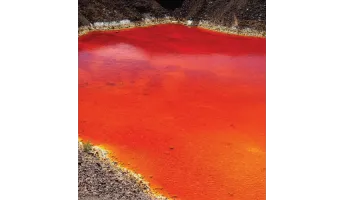
The invention uses maghemite nanoparticles at pH levels below 5 to remove sulphate, manganese, copper, nickel, cobalt, and zinc ions from acid mine drainage (AMD). In traditional AMD treatment methods, these contaminants are usually removed only at higher pH levels, which requires expensive alkaline