This technology uses Unmanned Aerial Vehicles (UAVs) fitted with a camera to calibrate heliostats in large Concentrating Solar Power (CSP) or Concentrating Solar Thermal (CST) tower systems. The UAV does not have a single fixed position and provides several advantages over traditional methods using
A computer implemented method, system or programme for combining a three-dimensional PET scan and a CT scan of a body into a combined image for segmentation, comprising of: Co-registering each of the PET scan and the CT scan as an input with reference to each other. Extracting metadata from the
The DarkLight™ Catalyst is an advanced, biosynthesised titanium dioxide (TiO₂) photocatalyst that functions efficiently without the need for visible or ultraviolet light. Developed through a green synthesis process using natural extracts from Hibiscus sabdariffa, the material features an oxygen
The PureLite Reactor™ provides a highly efficient and customisable platform for various applications. Its energy-efficient LED light sources, advanced control systems, and versatile design give researchers precise control over photochemical reactions, making it a vital tool in environmental science
A method for inference based on multivariate message-based graph structures and not the well-known Tanner Graph structure. Tanner graphs are known to have poor convergence with variables greater than 1, to compensate LDPC codes are created to avoid this scenario. The invented method allows for
MagNanoClean™ is an innovative method and apparatus for fluid treatment that leverages charged nanoparticles and a moving magnetic system to remove impurities efficiently and sustainably. In this process, contaminants are trapped by the charged nanoparticles suspended in a reactor. When activated
The technology is a membrane-based system developed from waste expanded polystyrene (EPS) using electrospinning to create a nanofibrous material with superhydrophobic (water-repelling) and superoleophilic (oil-attracting) properties. It enables crude oil adsorption, recovery, and membrane
AquaCarbon™ introduces a high-performance membrane technology designed for membrane distillation desalination. The innovation integrates multi-walled carbon nanotubes (MWCNTs) into polyvinylidene fluoride (PVDF) membranes to create a robust, highly hydrophobic, and porous structure capable of
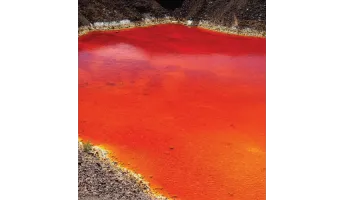
The invention uses maghemite nanoparticles at pH levels below 5 to remove sulphate, manganese, copper, nickel, cobalt, and zinc ions from acid mine drainage (AMD). In traditional AMD treatment methods, these contaminants are usually removed only at higher pH levels, which requires expensive alkaline

This technology offers an innovative and eco-friendly method for producing ferric chloride (FeCl₃), a commonly used coagulant in water purification, by recovering Fe(III) from acid mine drainage (AMD). AMD is a significant pollutant generated by mining activities and typically contains high levels