Many filtration systems overlook a major issue for oxygen-sensitive liquids like wine: oxidation during transfer and filtration. Even small amounts of oxygen can degrade quality. This apparatus provides a closed, inert-gas-pressurized filtration system that keeps wine fully protected from oxygen
The DarkLight™ Catalyst is an advanced, biosynthesised titanium dioxide (TiO₂) photocatalyst that functions efficiently without the need for visible or ultraviolet light. Developed through a green synthesis process using natural extracts from Hibiscus sabdariffa, the material features an oxygen
The technology relates to an innovative process for converting waste cooking oils to biosurfactants that are applicable to various industries. The process utilises a special yeast strain to convert waste into biosurfactant at competitive concentrations. The downstream process includes a bioreactor
The PureLite Reactor™ provides a highly efficient and customisable platform for various applications. Its energy-efficient LED light sources, advanced control systems, and versatile design give researchers precise control over photochemical reactions, making it a vital tool in environmental science
During beer production, around 2–4% excess yeast is generated and removed, causing significant beer loss of up to 400 mL for every litre of yeast discarded. Since beer production is highly water-intensive (about 3.5 L of water per litre of beer), this loss also represents substantial wasted water
MagNanoClean™ is an innovative method and apparatus for fluid treatment that leverages charged nanoparticles and a moving magnetic system to remove impurities efficiently and sustainably. In this process, contaminants are trapped by the charged nanoparticles suspended in a reactor. When activated
The technology is a membrane-based system developed from waste expanded polystyrene (EPS) using electrospinning to create a nanofibrous material with superhydrophobic (water-repelling) and superoleophilic (oil-attracting) properties. It enables crude oil adsorption, recovery, and membrane
AquaCarbon™ introduces a high-performance membrane technology designed for membrane distillation desalination. The innovation integrates multi-walled carbon nanotubes (MWCNTs) into polyvinylidene fluoride (PVDF) membranes to create a robust, highly hydrophobic, and porous structure capable of
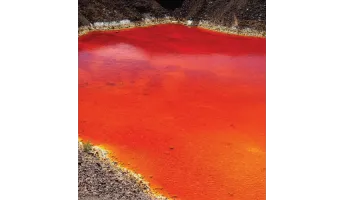
The invention uses maghemite nanoparticles at pH levels below 5 to remove sulphate, manganese, copper, nickel, cobalt, and zinc ions from acid mine drainage (AMD). In traditional AMD treatment methods, these contaminants are usually removed only at higher pH levels, which requires expensive alkaline

This technology offers an innovative and eco-friendly method for producing ferric chloride (FeCl₃), a commonly used coagulant in water purification, by recovering Fe(III) from acid mine drainage (AMD). AMD is a significant pollutant generated by mining activities and typically contains high levels