

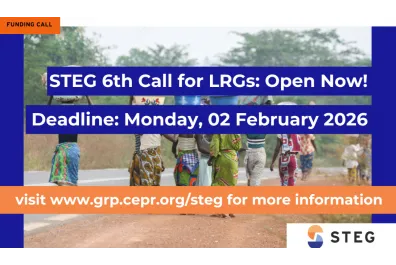
The Structural Transformation and Economic Growth (STEG) programme invites applications for its sixth call for Larger Research Grants (LRGs), designed to support rigorous, policy‑relevant research on structural transformation, productivity and long‑run growth in low‑income countries, particularly in sub‑Saharan Africa. LRGs provide up to £100,000 per project to fund research assistance, data collection and/or purchase, teaching buyouts or equivalent remuneration for principal investigators and co‑investigators, as well as travel to field sites, including when working primarily with secondary data.
For this call, the £100,000 cap can be exceeded for projects with extraordinary data collection costs in low‑income countries, recognising the high cost and importance of improved data to study structural transformation; any additional budget must be reasonable, clearly justified, and data collected must be made publicly available by the end of the grant. Funded projects are expected to be completed within 24 months, with funding decisions aimed within five months of the deadline and contracts signed within one month of the final decision, which is also the anticipated project start date. STEG emphasises policy relevance for low‑income and sub‑Saharan African countries, requiring all funded projects regardless of where data are collected to discuss lessons for policymakers in these contexts in their final outputs.
Research topics may address broad systemic patterns of structural change and growth in low‑income countries over time or across space, or more narrowly defined questions that fall under one or more of STEG’s six research themes:
- Data, measurement and conceptual framing
- Firms, frictions, spillovers and industrial policy
- Labour, home production and household‑level structural transformation
- Agricultural productivity and sectoral gaps
- Trade and spatial frictions
- The role of the public sector
In addition, STEG prioritises three cross‑cutting issues that intersect many areas of structural transformation: gender, climate change and the environment, and inequality and inclusion, and research that substantively engages with these dimensions will receive particular consideration. Proposals may also focus on middle‑income countries if they clearly demonstrate how findings will inform growth processes or policy in specific low‑income countries, especially in sub‑Saharan Africa. LRGs cover the same broad substantive scope as STEG’s Small Research Grants but are intended for projects with greater financial needs and are expected to generate multiple outputs or more fundamental contributions.
Countries eligible to apply / geographic focus
- Who can apply (by institution/country):
- STEG welcomes applications from researchers worldwide and encourages collaborations between researchers from low‑, middle‑ and high‑income countries.
- Proposals cannot include researchers based at Russian institutions, due to current sanctions and related restrictions.
- Country focus for research:
- Funding priority is given to research with clear policy relevance for low‑income countries, particularly in sub‑Saharan Africa.
- Projects focusing on middle‑ or high‑income countries are only eligible if they convincingly demonstrate how results will inform policy in specific low‑income countries.
In short, researchers from any country (except those based at Russian institutions) may apply, but research must centre on or clearly speak to the policy needs of low‑income, especially sub‑Saharan African, countries.
Eligibility and applicant profile
Principal investigators must hold a PhD or be enrolled in a PhD programme; there are no formal qualification requirements for co‑investigators, though most co‑investigators on STEG‑funded projects are also PhD holders or candidates, and the team’s overall expertise is a key evaluation factor. STEG welcomes PhD students as PIs, but given the scale and complexity of LRGs, students applying alone may find it difficult to compete with more established researchers; PhD candidates are therefore encouraged to apply as part of a team with senior co‑investigators and, if acting as PI, must arrange for a support letter from their supervisor within two weeks of the deadline.
Grants are contracted to eligible institutions (legally registered entities that are financially sound, compliant with tax, social security and labour regulations, and free from convictions related to fraud, corruption or similar offences), and joint proposals from consortia are permitted provided there is one lead institution and a suitable legal arrangement (such as a consortium agreement, MoU or sub‑contract). In exceptional cases, CEPR may host a project directly where an otherwise suitable team lacks an eligible host institution. All grantees must adhere to STEG’s Code of Conduct for Researchers and CEPR policies on conflicts of interest, fraud, bribery, corruption and privacy, and must submit all proposal documents in English, with financial information in GBP.
Key funding details and timeline
- Grant size: Up to £100,000 per project, with the cap relaxed for justified, high‑cost data collection in low‑income countries.
- Eligible costs: Research assistance, data collection/purchase, teaching buyouts or equivalent PI/co‑I remuneration, and field travel (including when using secondary data), all subject to value‑for‑money and LRG Budget Guidelines.
- Project duration: Up to 24 months.
- Decision timeline: Funding decisions targeted within five months of the deadline; contracts to be signed within one month of the decision, which also marks the expected project start date.
- Application deadline: 02 February 2026, 23:59 BST; late applications are automatically considered in the next regular LRG round.
How to apply
Applicants must prepare: a project title and abstract; CVs and contact details for all investigators; a proposal summary (max 3 pages); a full proposal (core sections up to 15 pages); a detailed budget; and institutional legal/financial verification documents, all using the official templates available on the LRG funding page. Proposals are submitted via the LRG Application Form on CEPR’s Hub platform, after reviewing documentation on eligibility, country criteria, how to apply online, budget guidelines and FAQs.
Applications are evaluated on: research quality, policy relevance, feasibility and credibility, value for money, and contribution to expanding the field, with detailed weighting and processes outlined in the LRG Applicant Guide. Due to high competition (historically fewer than about 5% of applications are funded), STEG generally does not provide individual feedback on unsuccessful proposals.
Contact for queries: STEG Team – steg@cepr.org.
Click HERE for Application Templates and Useful Documents.
Click HERE to visit the official website.