

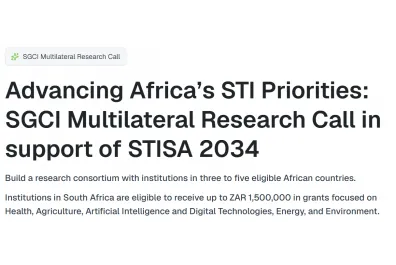
The Science Granting Councils Initiative (SGCI) has launched its 2026 Multilateral Research Call to support African-led, multi-country research projects that advance the Science, Technology and Innovation Strategy for Africa (STISA 2034).
Backed by US$12 million in research funding, the programme seeks to strengthen cross-border scientific collaboration, generate policy-relevant research, and accelerate innovation that addresses Africa's most pressing development challenges.
In South Africa, the call is administered by the National Research Foundation (NRF), with eligible South African institutions able to receive grants of up to ZAR 1.5 million per consortium member. The initiative is supported by the participating African Science Granting Councils together with the Government of Norway, the United Kingdom's Foreign, Commonwealth & Development Office (FCDO), the Wellcome Trust, the International Development Research Centre (IDRC) and the African Union Development Agency (AUDA-NEPAD).
Funding Available
Successful South African consortium members may receive grants of up to:
ZAR 1,500,000
Funding supports collaborative research projects running for up to 36 months.
Research Priority Areas
The call supports collaborative research across five strategic themes aligned with STISA 2034:
- Health
- Agriculture
- Artificial Intelligence and Digital Technologies
- Energy
- Environment
These themes aim to strengthen Africa's resilience, competitiveness and sustainable development through science, technology and innovation.
Who Can Apply?
South African applicants must:
- Be South African citizens or permanent residents residing in South Africa.
- Be affiliated with a recognised public higher education institution or research institution.
- Participate in a consortium comprising institutions from at least three eligible African countries.
- Include Historically Disadvantaged Institutions (HDIs) within the South African consortium.
Researchers from SMEs, industry and NGOs may participate as consortium members but cannot serve as the Principal Investigator and are expected to fund their own participation.
Consortium Requirements
Applicants must establish an African research consortium that includes:
- One lead applicant institution
- A minimum of three participating institutions from at least three eligible SGCI countries
- Up to five consortium institutions representing five participating African countries
The programme also provides an optional matchmaking platform to help researchers identify collaborators and strengthen consortium partnerships before submission.
Why This Opportunity Matters
Unlike traditional research grants, the SGCI Multilateral Research Call is specifically designed to support research that delivers measurable impact beyond academia.
Successful projects are expected to:
- Address Africa's strategic development priorities
- Generate evidence that informs policy and decision-making
- Strengthen long-term African research partnerships
- Build institutional and researcher capacity
- Promote commercialization and real-world adoption of research outcomes
- Accelerate implementation of the African Union's STISA 2034 agenda
Important Dates
- Information Webinar 1: 23 July 2026
- Information Webinar 2: 13 August 2026
- Expression of Interest Deadline: 25 September 2026 (23:59 EDT)
- Shortlisted Applicants Notified: 19 October 2026
Eligible Countries
Researchers must build consortia with institutions from eligible SGCI participating countries, including:
- Botswana
- Burkina Faso
- Côte d'Ivoire
- Ethiopia
- Ghana
- Kenya
- Malawi
- Mozambique
- Namibia
- Nigeria
- Rwanda
- Senegal
- Sierra Leone
- South Africa
- Tanzania
- Uganda
- Zambia
- Zimbabwe
- (and other eligible SGCI member countries as outlined in the official call documentation).
Key Focus Areas
- Health Systems
- Agriculture
- Artificial Intelligence
- Digital Technologies
- Renewable Energy
- Climate Resilience
- Biodiversity
- Water Security
- Environmental Sustainability
- Research Commercialisation
- Policy Development
Click HERE to visit the official website.