


The National Cleantech Innovation Challenge – LIMPOPO
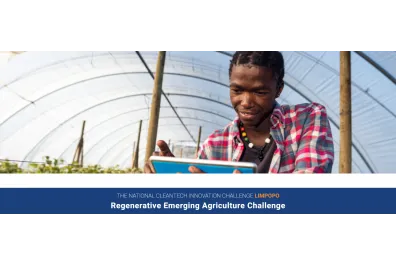
Regenerative Emerging Agriculture Challenge
Advancing Climate-Smart, Off-Grid and Regenerative Farming Systems for Limpopo’s Emerging Agricultural Sector
Limpopo is one of South Africa’s most important agricultural provinces, contributing over 40% of the country’s citrus production. Yet its semi-arid climate, dependence on rainfed systems, shared water resources, and reliance on unstable national grid infrastructure expose emerging and small-scale farmers to severe climate and energy risks.
Rising temperatures, recurring droughts, erratic rainfall, and water stress within the Limpopo River catchment threaten agricultural productivity, rural livelihoods, and long-term food security. At the same time, many rural communities remain energy-constrained, limiting their ability to irrigate, process, store, and transport agricultural produce efficiently.
The Limpopo Regenerative Emerging Agriculture Challenge seeks scalable, inclusive, and applied clean technology solutions that integrate:
- Climate-smart agriculture
- Off-grid renewable energy systems
- Sustainable water management
- Soil regeneration and ecosystem restoration
This challenge operates within the water–energy–food nexus, promoting regenerative agricultural systems that:
- Enhance climate resilience
- Improve productivity and income stability
- Reduce environmental degradation
- Empower rural entrepreneurs and cooperatives
Potential innovation areas include:
- Agrivoltaics (solar + agriculture integration)
- Solar-powered boreholes and irrigation systems
- Precision and micro-irrigation technologies
- Rainwater harvesting and water reuse systems
- Drought-resistant crops and agroforestry models
- AI-powered farm monitoring and climate advisory tools
- Circular bioeconomy and waste valorisation solutions
The challenge also presents opportunities for mining and industrial stakeholders to strengthen their social license to operate by supporting local agribusiness and clean energy transitions.
Who Can Apply
Applications are invited from innovators and enterprises developing or piloting clean technology solutions to advance regenerative, small-scale agriculture in Limpopo Province.
Eligible Participants Include:
Very Early-Stage Innovators
- Farmer groups, cooperatives, and local inventors
- Working prototypes or proof-of-concept technologies (TRL ≥ early validation)
Examples:- Small biogas units
- Smart irrigation kits
- Evaporative cooling systems
- AI- or robotics-enabled farm tools
Early-Stage Entrepreneurs (SMEs)
- Mini-grid and solar solution providers
- Solar-powered borehole systems
- Cold storage innovations
- Mini agro-processing equipment
- Circular bioeconomy applications
Growth-Stage Enterprises
- Agrivoltaics developers
- Off-grid renewable energy integrators
- Waste-to-value and bio-based input manufacturers
- Agro-processing innovations strengthening supply chains
International applicants may participate in partnership with locally registered entities, with clear localisation, skills transfer, and job creation strategies.
Challenge Problem Statement
The Limpopo agricultural ecosystem faces systemic vulnerabilities:
1. Climate & Energy Insecurity
- Heat stress and prolonged droughts
- Off-grid or unreliable electricity supply
- Limited irrigation and storage capacity
2. Water & Soil Degradation
- Depleted soil carbon and fertility
- Over-reliance on rainfed systems
- Poor water-use efficiency
3. Limited Access to Affordable Clean Technologies
- High-cost imported technologies
- Lack of smallholder-suited solutions
- Minimal local manufacturing
4. Data & Capacity Gaps
- Limited access to weather, soil, and energy-use data
- Weak digital advisory systems
- Low adoption of AI-driven monitoring tools
5. Market & Infrastructure Constraints
- Fragmented value chains
- Limited finance access
- Weak commercialization pathways
Objectives of the Challenge
- Accelerate adoption of regenerative clean technologies in emerging agriculture
- Integrate renewable energy into farm operations (irrigation, cooling, processing)
- Stimulate low-cost, modular, locally manufactured solutions
- Enable digital and AI-powered farm management tools
- Strengthen rural entrepreneurship and circular economy models
- Improve climate resilience, productivity, and food security
What Are They Looking For
Solutions should:
- Be piloted, validated, or deployment-ready clean technologies
- Integrate renewable energy, water efficiency, and soil regeneration
- Be affordable, modular, and scalable for smallholder adoption
- Empower youth, cooperatives, and local enterprises
- Align with Limpopo’s agroecological conditions
- Demonstrate practical implementation potential
What Are They Not Looking For
- High-capital infrastructure-heavy solutions
- Concepts without prototypes or validation
- Technologies misaligned with Limpopo’s climate or crop profile
- Research-only projects without applied outcomes
- Interventions excluding local participation and skills transfer
Click HERE to visit the official website.