


National Cleantech Innovation Challenge – KwaZulu-Natal Clean Port Logistics Challenge
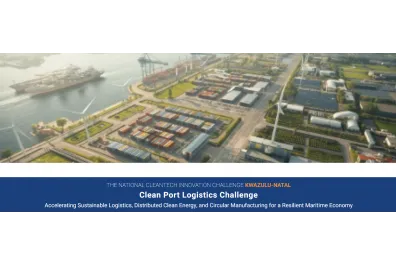
The Clean Port Logistics Challenge forms part of the National Cleantech Innovation Challenge and is focused on accelerating sustainable logistics, distributed clean energy, and circular manufacturing solutions across KwaZulu-Natal’s maritime economy.
KwaZulu-Natal is home to the Durban and Richards Bay ports, two of Africa’s busiest trade corridors and critical drivers of South Africa’s import-export economy. However, these industrial ecosystems are currently:
- Highly carbon-intensive
- Dependent on unstable grid electricity
- Burdened by inefficient logistics systems
- Strained by unmanaged industrial and agro-processing waste
- Vulnerable to water scarcity and infrastructure pressure
This Challenge seeks to catalyse scalable, modular, and high-impact cleantech solutions that reduce emissions, strengthen energy resilience, and unlock circular industrial value chains within port and logistics environments.
In collaboration with Transnet, Toyota SA, MSC, Sappi, Mondi, and eThekwini Municipality, the initiative aims to position KwaZulu-Natal as a national leader in:
- Green industrialisation
- Sustainable port operations
- Innovation-driven job creation
- Just Energy Transition implementation
The Challenge aligns directly with South Africa’s Just Transition Strategy and the 2030 Climate Change Plan, ensuring inclusive participation of women, youth, SMEs, and township innovators in transforming the province’s logistics economy.
Challenge Focus Areas
Applicants must demonstrate measurable impact across one or more of the following areas:
1. Low-Emission Freight & Clean Mobility
- Electrified or hydrogen-powered freight solutions
- Alternative fuel systems
- Fleet optimisation technologies
- Emissions reduction platforms
2. Distributed Renewable Energy & Storage
- Renewable microgrids for ports and industrial zones
- On-site clean energy generation
- Battery storage integration
- Energy resilience solutions for manufacturing and cold storage
3. Waste-to-Resource & Circular Manufacturing
- Organic waste-to-bioenergy systems
- Industrial symbiosis models
- Circular processing systems
- Waste-to-value manufacturing innovations
4. Water-Efficient Industrial Processing
- Industrial water recycling
- Smart water monitoring systems
- Reduced freshwater dependency technologies
5. Digital Efficiency Platforms
- Data-driven logistics optimisation
- Transparency tools for supply chains
- Emissions tracking platforms
- Smart port technology integration
Who Can Apply
Eligible participants include:
- Entrepreneurs and start-ups
- Research teams and university spin-outs
- Small and growing cleantech enterprises
- Prototype-stage or early commercialisation ventures
- Innovators ready for pilot deployment within port or industrial environments
Technology Readiness: Solutions must be sufficiently developed for pilot testing in real port or industrial settings.
International applicants may apply in partnership with locally registered South African entities, provided localization, skills transfer, and job creation are central to the proposal.
Key Objectives of the Challenge
- Reduce logistics-related emissions
- Strengthen industrial energy resilience
- Convert waste streams into economic value
- Promote circular manufacturing systems
- Enhance port efficiency and competitiveness
- Create inclusive, innovation-led jobs
What We Are Looking For
Practical, scalable solutions
Modular technologies adaptable to SMEs and large industry
Measurable impact in emissions reduction and energy savings
Business models that are commercially viable
Inclusive partnerships with municipalities, ports, and manufacturers
Strong participation of women, youth, and township innovators
What We Are Not Looking For
Generic or copy-paste solutions without adaptation to KZN
Fossil-based technologies rebranded as “green”
Early-stage R&D requiring multi-year pilots (>3 years)
Non-scalable, high-capital exclusive interventions
Awareness-only projects without implementation
Solutions that exclude local economic participation
About the Implementing Partner
Start-Up Culture (SUC) is a TIA-funded national entrepreneurship hub driving clean technology, digital innovation, and enterprise development across South Africa.
In KwaZulu-Natal, SUC operates through a hub-and-spoke ecosystem linking:
- Township entrepreneurs
- Universities and research institutions
- Industry partners
- Municipal stakeholders
Through partnerships with PEETS (University of Johannesburg), Innovate Durban, BuzzHub, and DUT, SUC provides prototyping support, mentorship, incubation, and investor-readiness programming.
The Clean Port Logistics Challenge builds on SUC’s track record in:
- Clean mobility
- Circular economy solutions
- Inclusive industrial innovation
Strategic Impact
This Challenge positions KwaZulu-Natal as a flagship province for:
- Sustainable port operations
- Climate-resilient logistics systems
- Green industrial competitiveness
- Just and inclusive economic transformation
Click HERE to view the official website