


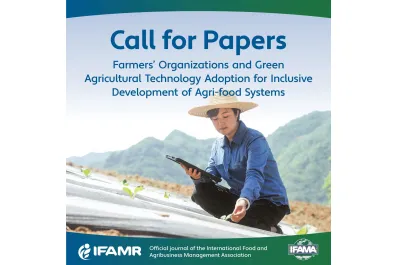
The International Food and Agribusiness Management Review (IFAMR) invites researchers and practitioners to submit papers for a special issue examining how farmers’ organizations facilitate the adoption of green agricultural technologies and contribute to inclusive, resilient and sustainable agri-food systems.
The special issue explores how cooperatives, producer organisations, farmers’ associations and other forms of collective action can help farmers access sustainable technologies, overcome adoption barriers and participate more effectively in agricultural development.
It seeks theoretical, empirical and practice-oriented research that strengthens the evidence on the role of farmers’ organizations in supporting smallholder farmers, women, young farmers, remote communities and other groups facing barriers to resources, technology and markets.
The findings are intended to inform policymakers, practitioners and development agencies working to improve agricultural productivity, environmental sustainability and inclusive rural development.
Purpose and Objectives
The special issue aims to:
- Examine how farmers’ organizations influence the adoption of green agricultural technologies.
- Assess how collective action improves access to information, training, services, inputs and markets.
- Investigate whether farmers’ organizations help reduce inequalities in technology adoption.
- Evaluate the economic, environmental and social outcomes associated with green agricultural technologies.
- Generate evidence that can inform agricultural policies, development programmes and institutional strategies.
Areas of Focus
Contributions examining technology adoption among vulnerable and underserved farming groups are particularly encouraged.
1. Input-Reducing Technologies
- Soil testing-based fertilisation.
- Precision fertilisation and pesticide application.
- Slow-release fertilisers.
- Biofertilisers as alternatives to chemical fertilisers.
- Integrated pest management.
- Precision and water-saving irrigation.
2. Resource-Conserving Technologies
- Conservation tillage.
- Straw returning.
- Cover cropping.
- Crop rotation systems.
- Contour farming.
3. Environmentally Friendly Technologies
- Organic farming practices.
- Biological pest control.
- Biopesticides.
- Nitrogen- and phosphorus-reduction technologies.
4. Climate-Smart Agricultural Technologies
- Drought-resistant and water-efficient crop varieties.
- Stress-resistant crop varieties.
- Low-emission nutrient management.
- Methane mitigation in crop production.
- Livestock emission-reduction technologies.
- Agricultural carbon sequestration practices.
5. Digital and Precision Agriculture
- Remote-sensing-based monitoring.
- Drone-assisted precision pesticide application.
- Smart irrigation systems.
- Soil sensor technologies.
- Agricultural big-data platforms.
- Intelligent agricultural machinery.
6. Circular Agriculture Technologies
- Recycling livestock manure into organic fertiliser.
- Converting agricultural waste into bioenergy, including biogas.
- Reusing agricultural by-products.
- Integrated crop–livestock farming systems.
Who Should Contribute?
The call is relevant to:
- Academic researchers and university scholars.
- Agricultural economists and agribusiness researchers.
- Specialists in agricultural technology adoption and innovation.
- Researchers studying farmers’ organizations, cooperatives and collective action.
- Researchers in sustainable agriculture, climate-smart agriculture and rural development.
- Practitioners and development professionals with relevant research findings.
Research Themes and Suggested Questions
Potential contributions may examine:
- How do farmers’ organizations reduce information and transaction costs associated with adopting green technologies?
- Do cooperatives and producer organizations improve technology access for smallholders, women and young farmers?
- How does membership in farmers’ organizations influence farm productivity, profitability and environmental performance?
- Which institutional arrangements most effectively support inclusive access to green agricultural technologies?
- How do digital agricultural tools affect technology adoption among resource-constrained farmers?
- What barriers prevent farmers’ organizations from promoting sustainable and climate-resilient agricultural practices?
These are illustrative research directions; submissions should align with the special issue's overall theme and requirements.
Geographic Scope
The call invites research relevant to global agri-food systems. No country-specific eligibility restriction is stated in the call for papers.
Examples of countries from which relevant research could originate include:
- South Africa
- Kenya
- Ghana
- India
- China
- Japan
- Australia
- New Zealand
- Brazil
- Argentina
- United States
- Canada
- Germany
- Italy
- Netherlands
These examples illustrate the potential international relevance of the topic and are not an official list of eligible countries.
Submission Requirements
Authors must:
- Prepare a complete manuscript in accordance with IFAMR's submission guidelines.
- Submit the full paper through the journal's Editorial Manager portal.
- Select “Farmers’ Organizations and Green Agricultural Technology Adoption” as the article type to ensure consideration for the special issue's expedited review process.
- Participate in the journal's standard double-blind peer-review process.
Submissions will first be screened for relevance and quality before being assigned to reviewers. Acceptance is not guaranteed.
Important Dates
- Full paper submission deadline: 15 December 2026
- Expected publication of the completed special issue: 2027
The December 15, 2026 deadline reflects the updated call information. An earlier September 30, 2026 date appears in the supplied text's submission instructions, but the special issue timeline and updated call document specify December 15, 2026.
Publication and Funding Information
Accepted papers may be published online ahead of the completed special issue, which is expected in 2027.
This is a call for academic papers, not a grant or funding opportunity. No author funding or research grant is specified in the supplied call information.
Submission Portal and Enquiries
Journal: International Food and Agribusiness Management Review (IFAMR)
Submission portal: IFAMR Editorial Manager
Submission guidelines: IFAMR Author Submission Guidelines
Guest editor contacts:
- Prof. Wanglin Ma — Wanglin.Ma@lincoln.ac.nz
- Dr. Dil Rahut — drahut@adbi.org
- Prof. Marco A. Marini — marco.marini@uniroma1.it
Click HERE to visit the official website.