

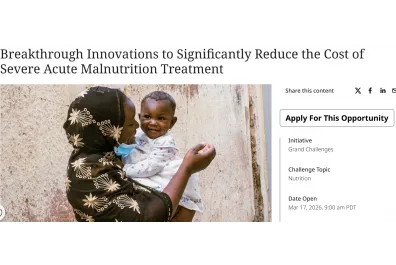
The Grand Challenges initiative has launched a global call for proposals seeking breakthrough innovations that can significantly reduce the cost of treating Severe Acute Malnutrition (SAM) while maintaining or improving treatment outcomes.
Severe Acute Malnutrition remains one of the leading causes of child mortality globally, particularly in Sub-Saharan Africa and South Asia. Despite the availability of treatment solutions such as Ready-to-Use Therapeutic Food (RUTF), overall treatment costs remain high due to logistics, delivery systems, staffing, and operational inefficiencies.
This call focuses on system-level innovations that can improve cost-effectiveness across the treatment ecosystem. The objective is to support solutions that can achieve a 20% to 30% or greater reduction in the total cost per child treated, without relying on reducing the price of therapeutic food itself.
The initiative is structured as an idea-sourcing and proof-of-concept funding mechanism, targeting scalable innovations that can transform how treatment is delivered, monitored, and optimised in real-world settings.
Eligible Countries
Global (with strong relevance to Sub-Saharan Africa and South Asia)
Eligible Organisations
The call is open to:
- Universities and academic institutions
- Research institutes
- Non-governmental organisations (NGOs)
- For-profit/private sector companies (subject to global access requirements)
- Consortia combining research, technical, and implementation expertise
Consortia that include or are led by LMIC-based organisations are strongly encouraged.
Funding Structure
Applicants can apply under two funding options:
Option A:
- Up to USD 500,000
- Duration: up to 18 months
Option B:
- Up to USD 1,500,000
- Duration: up to 36 months
Challenge Objective
Proposals must demonstrate:
- A validated pathway to achieving 20%–30% or greater cost reduction per child treated
- A transparent and credible cost model
- Proof-of-concept feasibility (e.g., modelling, simulation, pilot data)
- A clear pathway to scalability and adoption
- Safeguards to ensure clinical outcomes and safety are not compromised
Focus Areas
Applicants may submit innovations across one or more of the following system-level areas:
1. Logistics and Distribution Optimisation
Improving supply chains, warehousing, transport, and delivery efficiency to reduce costs.
2. Treatment Protocols and Regimen Design
Developing adaptive, data-driven, or simplified treatment approaches that reduce resource use without compromising outcomes.
3. Program Delivery Models
Innovations in service delivery, including decentralised care, task-shifting, and integration with existing health systems.
4. Complicated (In-patient) SAM Care Optimisation
Reducing costs associated with inpatient care through improved clinical pathways and resource-efficient models.
Cross-Cutting Requirements
Proposals must include:
- A detailed cost reduction analysis
- Clear identification of affected cost drivers (e.g., logistics, staffing, visits)
- Evidence supporting feasibility and impact
- Data-sharing commitments for replication and policy use
- Consideration of environmental and operational impacts
- Responsible use of AI or digital tools (if applicable)
What Will Not Be Funded
The fund will not support:
- Clinical trials or efficacy-only studies
- Scaling of existing standard protocols without innovation
- Business-as-usual implementation activities
- Replication of existing approaches without significant improvement
- Proposals without a credible pathway to cost reduction
Key Dates
Opening Date: 17 March 2026
Deadline: 28 April 2026 (11:30 AM PDT)
Click HERE to visit the official website.