

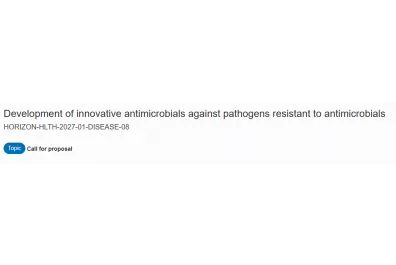
The European Commission has announced a forthcoming Horizon Europe Cluster 1: Health funding opportunity aimed at accelerating the development of innovative antimicrobial therapies to combat antimicrobial-resistant (AMR) bacterial and fungal pathogens.
Antimicrobial resistance remains one of the most significant global public health threats, reducing the effectiveness of existing treatments, increasing healthcare costs, and contributing to higher mortality rates worldwide. Through this call, Horizon Europe seeks to support the advancement of novel antibacterial and antifungal therapies capable of addressing critical resistant pathogens.
The call specifically supports the development of innovative antimicrobial candidates, including antibody-based therapies, that demonstrate at least one of the World Health Organization's innovation criteria, such as:
- New chemical class
- New biological target
- New mode of action
- No evidence of cross-resistance
Projects are expected to accelerate promising therapeutic candidates towards clinical development and market authorization pathways.
This is a Research and Innovation Action (RIA) under Horizon Europe Cluster 1 – Health.
Programme Information
Programme: Horizon Europe (HORIZON) – Cluster 1: Health
Topic Code: HORIZON-HLTH-2027-01-DISEASE-08
Type of Action: Research and Innovation Action (RIA)
Funding Instrument: Horizon Europe Grant Funding
Opening Date: 10 February 2027
Application Deadline: 13 April 2027 (17:00 Brussels Time)
Target Pathogens
Applicants must focus on the development of therapeutic candidates targeting only one of the following priority pathogens:
- Carbapenem-resistant Acinetobacter baumannii (CRAB)
- Carbapenem-resistant Enterobacterales (CRE)
- Third-generation cephalosporin-resistant Enterobacterales (C3GRE)
- Carbapenem-resistant Pseudomonas aeruginosa
- Methicillin-resistant Staphylococcus aureus (MRSA)
- Drug-resistant Aspergillus fumigatus
- Drug-resistant Candida species
Projects must clearly identify the selected target pathogen within the proposal.
Eligible Activities
Projects may include:
- Completion of pre-clinical in vivo studies
- Humanised animal model testing
- Non-human primate studies where required by regulators
- GMP manufacturing of therapeutic candidates
- Clinical safety and efficacy studies
- Regulatory pathway development towards market authorisation
- Development of innovative antibacterial therapies
- Development of innovative antifungal therapies
- Development of antibody-based antimicrobial treatments
Phage therapy projects are not eligible under this call.
Who Can Apply?
The call is open to:
- Universities
- Research Institutes
- Hospitals
- Clinical Research Organisations
- Biotechnology Companies
- Pharmaceutical Companies
- SMEs and Start-ups
- Public Research Organisations
- International Research Consortia
SME participation is strongly encouraged.
Consortium Requirements
This is a collaborative Horizon Europe call requiring a consortium consisting of:
- At least three independent legal entities
- Each entity must be established in a different eligible country
- At least one partner must be from an EU Member State
- At least two additional partners must be from different EU Member States or Horizon Europe Associated Countries
International partners from eligible non-EU countries may also participate where relevant.
Eligible Countries
The programme is open to organisations established in:
European Union Member States
All EU Member States are eligible.
Horizon Europe Associated Countries
Including:
- United Kingdom
- Switzerland
- Norway
- Iceland
- Türkiye
- Ukraine
- Tunisia
- Egypt
- Israel
- Canada
- New Zealand
- Republic of Korea
- Serbia
- Albania
- Montenegro
- North Macedonia
- Bosnia and Herzegovina
- Georgia
- Moldova
- Armenia
- Kosovo and others.
Eligible African Countries
The programme also allows participation from a wide range of African countries, including:
- South Africa
- Nigeria
- Kenya
- Ghana
- Ethiopia
- Tanzania
- Uganda
- Rwanda
- Zambia
- Zimbabwe
- Mozambique
- Namibia
- Botswana
- Malawi
- Senegal
- Côte d'Ivoire
- Cameroon
- Democratic Republic of Congo
- Republic of Congo
- Gabon
- Lesotho
- Eswatini
- Liberia
- Sierra Leone
- Guinea
- Togo
- Benin
- Burkina Faso
- Burundi
- Madagascar
- Mauritania
- Mauritius
- Somalia
- Sudan
- South Sudan
- Chad
- Djibouti
- Eritrea
- Equatorial Guinea
- Cabo Verde
- Comoros
- Niger
- Mali
- Angola
- Libya
- Morocco
- Algeria
- Tunisia
- Egypt
- São Tomé and Príncipe
- Gambia
- Guinea-Bissau
- Central African Republic and others.
Countries Specifically Encouraged to Participate
The European Commission specifically encourages participation from countries where antimicrobial-resistant pathogens are endemic or where outbreaks have occurred or are ongoing.
This creates strong opportunities for African institutions, hospitals, research centres, and biotechnology companies working on infectious diseases and antimicrobial resistance.
Click HERE to visit the official website.