

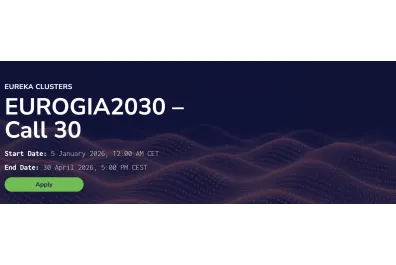
EUROGIA2030 Call 30 is now open for international collaborative research and development (R&D) projects focused on low-carbon technologies and climate innovation. This call forms part of the Eureka Clusters framework and supports transnational projects aimed at accelerating the development and commercialisation of sustainable energy and environmental solutions.
The programme is designed to stimulate industrial innovation and strengthen global competitiveness in clean technologies by fostering cross-border collaboration between SMEs, large companies, research organisations and universities.
Call Timeline
- Opening Date: 5 January 2026
- Closing Date: 30 April 2026 (17:00 CEST)
Aim and Purpose
EUROGIA2030 supports projects that contribute to:
- Carbon-free and renewable energy supply
- Green mobility and smart cities
- Sustainable housing and construction technologies
- Bio-resources and environmental innovation
The programme seeks to promote technological leadership, reduce greenhouse gas emissions, and drive sustainable economic growth through market-oriented R&D.
Eligibility Criteria (International Level)
To be eligible, projects must:
- Represent structured international cooperation
- Include at least two independent legal entities from a minimum of two participating Eureka countries
- Focus on the development of an innovative product, process or service with a clear commercialisation pathway
- Serve civilian purposes only
- Ensure that no single country or organisation accounts for more than 70% of the total project budget
Participating Countries
Austria, Brazil, Canada, Chile, France, Hungary, Ireland, Israel, Poland, Portugal, Singapore, South Africa, South Korea, Spain, Türkiye.
Funding is country-specific and managed by national funding agencies. There is no transfer of funds between countries; each country funds its own participants according to national regulations.
Country-Specific Funding Information
Austria
Funding Agency: Austrian Research Promotion Agency (FFG)
- Small companies: Up to 60% grant
- Medium companies: Up to 50% grant
- Large companies: Up to 50% (grant/loan mix)
- Universities and research organisations: Up to 50% under consortium arrangements
Funding instrument may vary depending on programme alignment.
Brazil
Funding Agency: EMBRAPII
- SMEs: Up to 50%
- Large companies: Up to 30%
Projects must involve at least one accredited EMBRAPII Unit and one Brazilian company (with active CNPJ). EMBRAPII funds up to one-third of project costs, with additional funding possible via BNDES or Sebrae.
Canada
Funding Agency: NRC IRAP
- SMEs: Up to 50%
- Large companies (>500 FTEs): Not eligible for direct funding
Universities may participate indirectly via SME partnerships. Canadian economic benefit is an evaluation criterion.
Chile
National funding details to be confirmed. Applicants should consult their national authority.
France
Funding Agency: Bpifrance
- Startups: Up to 80% (loan-based support)
- SMEs: Up to 60%
Maximum funding of €3 million per project. Research institutions participate as subcontractors.
Hungary
Funding Agency: National Research, Development and Innovation Office (NRDI)
- SMEs: 60–80% (up to 100% for basic research)
- Large companies: 25–75%
- Research organisations: Up to 100% (non-economic activities)
Funding range: 20–70 million HUF.
Ireland
Funding Agencies: Enterprise Ireland and national bodies
- SMEs: Up to 60%
- Large companies: Up to 40%
- Research organisations: Up to 100% (maximum €250,000 per organisation per project)
Research organisations require Irish company participation.
Israel
Funding Agency: Israeli Innovation Authority
- SMEs and large companies: Up to 50%
Only for-profit R&D companies registered in Israel are eligible. Academic institutions participate as subcontractors.
Poland
Funding Agency: National Centre for Research and Development (NCBR)
- SMEs: Up to 80% (research) / 70% (development)
- Large companies: Up to 75% (research) / 50% (development)
- Research organisations: Up to 100%
National application submission required.
Portugal
Funding Agency: ANI
- SMEs: Up to 80%
- Research organisations: Up to 85%
- Large companies: Generally not eligible
Financial autonomy requirements apply.
Singapore
Funding Agency: Enterprise Singapore
- SMEs: Up to 50%
- Large companies: Up to 30%
Applicant companies must be locally owned (minimum 30% local shareholding). Research institutions participate via enterprise partnerships.
South Africa
Funding Agency: Department of Science and Innovation (DSI)
- Startups: Up to 75%
- SMEs: Up to 70%
- Large companies: Up to 50%
- Universities: Up to 75%
- Research organisations: Up to 60%
Maximum grant: €300,000 per project.
Projects must be led by SMEs. National pre-notification and post-deadline submission to DSI are required. Transformation priorities (including Black, women and youth participation) are considered.
South Korea
National funding information to be confirmed. Applicants should engage early with national authorities.
Spain
Funding Agency: CDTI
- Loan up to 75% of eligible costs (with partial non-repayable component)
- Alternative INNOGLOBAL grant scheme up to 80% (regional eligibility applies)
Universities participate via industry subcontracting.
Türkiye
Funding Agency: TÜBİTAK
- SMEs: Up to 75%
- Large companies: Up to 60%
Universities may participate as subcontractors. National submission via TÜBİTAK’s PRODİS system required.
Evaluation Criteria
Applications are evaluated on:
- Impact – Market relevance, environmental and societal benefits, commercialisation plan
- Excellence – Degree of innovation and technical feasibility
- Quality of Implementation – Strength of consortium, project planning and cost structure
- Overall perception – Strategic importance and international added value
How to Apply
Applicants must:
- Contact their national funding agency to confirm eligibility and funding conditions.
- Create a consortium and submit one application per consortium through the Eureka application portal.
- Upload required annexes (Gantt chart, signed forms and supporting documentation).
- Complete any additional national submission requirements.
Successful projects will receive the EUROGIA2030 Eureka label, followed by national funding approval processes.
Click HERE to visit the official website.