


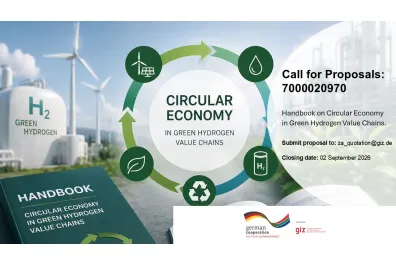
The Deutsche Gesellschaft für Internationale Zusammenarbeit (GIZ), through the Promoting Value Chains for Critical Raw Materials and Green Hydrogen and Derivatives in South Africa (H2.SA II / BVC) project, is inviting qualified service providers to develop a comprehensive and practical Handbook on Circular Economy in Green Hydrogen Value Chains.
The assignment responds to the growing role of green hydrogen (GH2) in South Africa's energy transition and the need to integrate circular economy principles across the green hydrogen and Power-to-X (PtX) value chains. The handbook is intended to strengthen knowledge and capacity among South African stakeholders and provide practical guidance on how circularity can be incorporated into green hydrogen systems.
The handbook will address the integration of circular economy principles across areas including zero-carbon electricity supply, electrolysis, water use, Power-to-X derivatives, by-product valorisation and end-of-life management, while also examining environmental, social, economic, policy and regulatory considerations.
Importantly, the assignment is intended to demonstrate that circularity is not only an environmental compliance consideration, but can create opportunities for new industries, improved resource efficiency, reduced operational costs, localisation, SMME participation and increased business competitiveness.
The opportunity is particularly relevant to organisations with demonstrated expertise in circular economy/resource efficiency, green hydrogen, Power-to-X, sustainability, energy systems, environmental management, economic analysis and technical knowledge development.
What the Assignment Involves
The appointed service provider will be responsible for a structured process covering:
- Inception and project planning, including an implementation plan and kick-off engagement with GIZ.
- Literature review and baseline analysis covering relevant policies, regulatory frameworks, research and existing circular economy practices.
- Analysis of international, regional and South African best practices and case studies relevant to green hydrogen production, storage, transportation, utilisation and derivatives.
- Assessment of the drivers, barriers and gaps affecting the adoption of circular strategies across GH2/PtX value chains.
- Stakeholder mapping and engagement, including consultations, interviews and site visits to GH2/PtX projects where possible.
- Development of the structure and outline of the handbook in consultation with GIZ.
- Drafting of the handbook covering circular economy principles, green hydrogen technologies, GH2/PtX value chains, environmental and social considerations, economic and monetary considerations, policy and regulation, case studies and practical implementation guidance.
- A stakeholder review and validation workshop.
- Finalisation and professional formatting of the handbook for publication.
The final handbook is expected to be approximately 80–150 pages, including annexures and references.
Key Areas the Handbook Must Address
The handbook is expected to provide practical guidance on:
- Principles of the circular economy.
- Green hydrogen technologies.
- Circular economy integration across GH2/PtX value chains.
- Integration of green hydrogen and PtX into wider circular economy systems.
- Environmental and sustainability considerations.
- Social and economic considerations.
- Policy and regulatory implications.
- Local and international best practices.
- Practical implementation guidance for stakeholders.
It should also address the potential socio-economic benefits of circularity for industry, SMMEs and communities, alongside opportunities for resource efficiency, localisation and competitiveness.
Target Stakeholders
The handbook is intended to support South African stakeholders involved in the green hydrogen sector, including:
- Government institutions.
- Industry.
- Green hydrogen project developers.
- Practitioners.
- Academia and research institutions.
- Other relevant stakeholders involved in the GH2/PtX ecosystem.
Who Should Apply
This opportunity is suited to professional service providers/organisations with the technical expertise, personnel and capacity required to deliver the assignment.
The proposed team must demonstrate relevant expertise and experience in areas such as:
- Circular economy and resource efficiency.
- Green hydrogen and Power-to-X value creation.
- Energy, environmental sustainability and the green economy.
- Technical research, analysis and technical writing.
- Stakeholder engagement and consultation.
- Development of technical reports, policy guidance documents or handbooks.
- Environmental and social impact analysis.
- Economic analysis of supply chains.
The required core team includes a Team Leader, a Key Expert in Circular Economy, and a short-term expert pool of between two and three experts.
Key Expert Requirement
The Circular Economy Key Expert should have:
- A relevant Master's degree or equivalent in Environmental Management, Environmental Sciences, Engineering, Energy Systems, Sustainability or a related field.
- C1-level English proficiency.
- At least 10 years' experience in energy, environmental sustainability and/or the green economy.
- At least 5 years' experience specifically involving circular economy/resource efficiency, green hydrogen and PtX value creation.
- At least 2 years' regional experience in SADC or Sub-Saharan Africa on energy/sustainability projects.
- 10 years' development cooperation experience working in South Africa and neighbouring SADC countries on energy, infrastructure or large-scale industrial development projects.
Project Duration and Deliverables
The assignment is scheduled to run from 30 September 2026 to 30 April 2027.
Key milestones include:
- Kick-off meeting and implementation plan — within 2 weeks of contract signing.
- Literature review, Status Quo Report and Stakeholder Map — within 15 weeks.
- Handbook outline — within 17 weeks.
- Draft handbook — within 25 weeks.
- Review workshop — within 27 weeks.
- Final handbook — by 31 March 2027.
Funding / Contract Value
This is not a grant funding opportunity. It is a procurement/tender for professional services, meaning the successful applicant will enter into a contract with GIZ to deliver the specified services.
The Terms of Reference provides a costing framework for personnel, travel and other assignment costs. It also includes a R91,360 flexible remuneration budget and R50,000 for the stakeholder validation workshop. These are budgeted cost items within the procurement rather than a grant awarded to applicants.
IBP funding type: If IBP requires a funding category, I would not select "Grant funding", "Seed funding", "Equity investment" or any of the investment categories. This should be classified as a Procurement/Tender/Service Contract if that option is available. If IBP does not provide such an option, use "Other" rather than misrepresenting it as grant funding.
Application / Tender Process
Interested service providers must prepare a technical and financial tender in accordance with the GIZ tender documentation.
The technical proposal must explain the proposed methodology, strategy, stakeholder engagement approach, operational plan, project management arrangements, knowledge management and approach to achieving the required outputs.
The tender must be:
- Prepared in English.
- Structured according to the Terms of Reference.
- No more than 15 pages, excluding CVs.
- Accompanied by the required CVs for proposed personnel.
- Supported by CVs of proposed experts, with each CV limited to 4 pages.
- Submitted with the technical and financial bids separately in accordance with GIZ requirements.
GIZ's tender requirements specify that the tender is submitted electronically, with technical and financial bids submitted as separate components.
Project Assessment Criteria
The technical assessment places particular emphasis on the quality and relevance of the proposed technical and methodological approach.
Applicants should clearly demonstrate:
- A strong understanding of the assignment objectives and GH2/circular economy context.
- A credible and well-justified strategy for delivering the handbook.
- Identification of relevant stakeholders and a clear approach to stakeholder cooperation.
- A robust approach to project steering and coordination with GIZ.
- A realistic operational plan covering the required tasks and milestones.
- Strong knowledge management and potential for scaling the results.
- Appropriate project management arrangements.
- The qualifications and relevant experience of the proposed team.
Particular weight should therefore be placed on demonstrating technical credibility, relevant green hydrogen and circular economy experience, South African/SADC contextual knowledge, stakeholder engagement capability and the ability to translate complex technical information into an accessible, practical handbook.
Limitations / Important Considerations
Applicants should note the following:
- This is a competitive procurement opportunity, not a grant programme.
- The successful provider is expected to deliver a professional handbook of 80–150 pages, including annexures and references.
- The technical tender may not exceed 15 pages, excluding CVs.
- Each proposed expert's CV may not exceed 4 pages.
- The financial tender must follow the costing parameters specified by GIZ.
- GIZ does not guarantee that all specified expert days, travel, workshop costs or budgets will necessarily be used in full; these are maximum contractual limits.
- Travel must be agreed in advance, and GIZ requires consideration of lower-emission travel options and carbon-offsetting requirements for air travel.
- Preparation and submission of a tender does not itself qualify for remuneration or reimbursement from GIZ.
Country
South Africa
The assignment is specifically designed to support South African stakeholders and the South African green hydrogen ecosystem, including South African government, industry, project developers, practitioners, academia, SMMEs and communities.
Deadline
2 September 2026, 23:59 CET
The official GIZ South Africa tender listing confirms the closing date for Tender 7000020970 as 2 September 2026.
Click HERE to visit the official website.