


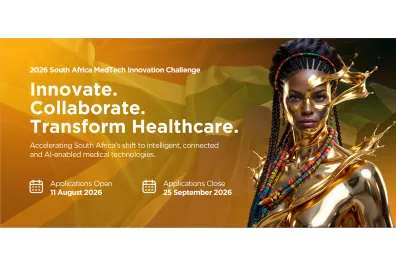
The 2026 South Africa MedTech Innovation Challenge is designed to identify and support innovative technologies that can modernise healthcare delivery through the integration of smart devices, artificial intelligence (AI) and digitally connected clinical workflows. The Challenge focuses specifically on transforming mechanical, analogue and legacy diagnostic, therapeutic and assistive systems into more intelligent, connected and accessible healthcare solutions.
The central focus is not simply on developing a medical technology in isolation. Applicants are expected to demonstrate how their innovation can contribute to an integrated MedTech ecosystem combining:
- Hardware or device capability
- AI-enabled functionality and decision support
- Secure workflow integration supporting triage, referral and healthcare service delivery.
The Challenge therefore provides an opportunity for South African innovators working across medical devices, diagnostics, AI-enabled healthcare and connected clinical pathways to position their technologies for further development, validation, implementation or scale.
Challenge Problem Statement
The Challenge seeks to address the need to modernise mechanical, analogue and legacy diagnostic, therapeutic and assistive technologies through the use of AI and secure, accessible clinical workflows.
The objective is to support technologies that can contribute to more intelligent and connected healthcare systems, while responding to the realities of healthcare delivery in South Africa.
Who Can Apply?
The Challenge is open only to legal entities and research groups operating in South Africa.
Eligible applicants include:
- Small, Medium and Large Enterprises registered in South Africa
- University-based research teams and innovators
- Science Council research teams and innovators
- Academic research laboratories.
Joint ventures, consortiums and collaborative teams may also apply, provided that one entity is designated as the lead applicant.
Applicants must also be able to demonstrate that they own the technology/innovation or have the legal rights to use it, and must provide the documentation required for verification.
Important eligibility restriction
The Challenge is exclusively South African. It is not an international open call. The applicant must be a South African legal entity or research group operating in South Africa.
Technology Readiness Levels and Categories
Applicants must select the category that matches the maturity of their technology.
Category A – TRL 4–7
Prototype-stage technologies undergoing validation
This category is intended for technologies that are still progressing through validation and development.
The Guidelines describe the maturity levels as:
- TRL 4: Proof of concept and safety demonstrated in a defined laboratory or animal model.
- TRL 5: Regulatory review indicating that clinical investigation may begin.
- TRL 6: Initial clinical investigation data demonstrating safety requirements and supporting progression to clinical safety and effectiveness trials.
- TRL 7: Evidence demonstrating substantial equivalence to a predicate device or therapeutic and safe use in an operational environment.
Category B – TRL 8–9
Market-ready or deployed technologies
- TRL 8: Investigation of the final Class III prototype in clinical trials.
- TRL 9: Production and distribution, with additional post-marketing studies and surveillance where required.
Applicants are responsible for selecting the appropriate category and ensuring that the claimed TRL is supported by evidence. The Organisers also reserve the right to reclassify an application where appropriate.
Important: Pure idea-stage concepts may not satisfy the minimum requirements. Category A applicants should generally be able to demonstrate a prototype, proof of concept or validated technology, while Category B technologies should be market-ready, operational or deployed.
Challenge Tracks
Applicants must select ONE primary track that best reflects the main value proposition of the technology. An applicant may not submit the same innovation across multiple tracks.
Track 1 – Diagnostics/Therapeutics and Devices
From Mechanical to Smart Systems
This track focuses on new digital diagnostic or therapeutic technologies, as well as the modernisation of existing mechanical or analogue systems through:
- Sensors
- Imaging technologies
- Embedded electronics
- Automation
- Connected devices
The emphasis is on transforming traditional technologies into smart, connected healthcare systems.
Track 2 – AI-Enabled Care and Triage
Intelligent Pre-Analysis
This track focuses on the use of AI for:
- Clinical decision support
- Triage
- Risk scoring
- Pattern recognition
- Similar healthcare functions
Technologies designed for resource-constrained environments, including offline or edge-based AI, are particularly encouraged.
Track 3 – Secure Workflow and Referral
Connected Clinical Pathways
This track focuses on technologies enabling:
- Secure, POPIA-compliant information exchange
- Referral management
- Low-bandwidth and offline-first operation
- Connectivity between devices, AI outputs, healthcare practitioners and health-system stakeholders.
What Applicants Should Demonstrate
A strong application should clearly explain:
- The problem being addressed.
- How the technology works.
- What hardware, software, AI or connected systems are used.
- Evidence of testing, validation, piloting or deployment.
- Who the intended users are.
- The healthcare context in which the solution will be used.
- The value proposition compared with existing approaches.
- How the technology could improve accessibility, affordability, clinical effectiveness, operational efficiency or health-system impact.
Applicants should also be able to demonstrate appropriate evidence for their maturity level, which may include:
- Prototype demonstrations
- Validation results
- Clinical or pilot data
- User feedback
- Research outputs
- Technical assessments
- Deployment records.
Market, Impact and Implementation
The Guidelines encourage applicants to address the broader impact and implementation potential of their technology, including:
- Health outcomes
- Improved healthcare access
- Cost efficiencies
- System-level benefits
- Economic benefits
- Social impact, particularly in resource-limited environments.
Depending on technology maturity, applicants may also need to demonstrate:
- Operational capacity
- Commercialisation plans
- Clinical adoption pathways
- Partnerships
- Manufacturing or implementation readiness
- Plans for scaling and sustainability.
Prize Funding
The Challenge will award six prizes across the two categories.
Category A – TRL 4–7
- 1st Place: R650,000
- 2nd Place: R350,000
- 3rd Place: R200,000
Category B – TRL 8–9
- 1st Place: R1,000,000
- 2nd Place: R500,000
- 3rd Place: R300,000.
The prize amounts are gross values and may be subject to applicable taxation and regulatory requirements. Payment is also conditional on successful due diligence, verification and any required contractual arrangements.
How Applications Will Be Assessed
Applications will go through a three-stage selection process:
Stage 1 – Eligibility and document verification
The application and supporting documentation are checked for eligibility and completeness.
Stage 2 – Technical and functional assessment
Eligible applications are assessed on the substance and performance of the proposed innovation.
Stage 3 – Final presentations and adjudication
Shortlisted applicants progress to the final presentation and judging stage.
Judging Criteria
Applications are assessed against:
- Innovation and Value Addition
- Clinical Utility and Usability
- Technical Robustness and Security
- Scalability and Health-System Integration Impact
- Team Capability
- Presentation.
Where applicants receive equal scores, the tie-break sequence prioritises Innovation and Value Addition, followed by Clinical Utility and Usability, then Scalability and Health-System Integration Impact.
Application Requirements
Applications must be submitted through the official Challenge website.
Applicants may be required to provide documentation including:
- Company registration documents
- Tax compliance documentation
- Proof of institutional affiliation
- University or institutional approval where applicable
- Technical documentation
- Prototype evidence
- Regulatory information
- Intellectual property information
- Other information requested by the Organisers and Competition Partners.
Applicants must provide truthful, complete and accurate information, and the Organisers may verify information provided. False, misleading or fraudulent information may result in disqualification.
Important Application Rules
Applicants should pay particular attention to these requirements:
- One entry per applicant only.
- An applicant may not submit the same or substantially similar innovation more than once.
- The same innovation cannot be entered across multiple categories or tracks.
- An individual cannot be a principal team member on more than one application relating to substantially the same innovation.
- Applications must comply with South African laws and regulations.
- There is no application, registration, administration or judging fee.
Applicants should also ensure that they select one appropriate category and one primary track before submitting. The Guidelines specifically provide an application-readiness checklist covering category selection, track selection, supporting documents and integration across device, AI and secure workflow components.
Intellectual Property
Applicants retain ownership of their intellectual property. Before submitting their applications, applicants are responsible for ensuring that they have sufficient statutory protection for their IP.
The Organisers and Competition Partners receive rights to use submitted materials for the administration of the Challenge, but future collaboration involving research, technology development, validation, commercialisation, licensing or investment must be governed by separate written agreements.
Prize Payment and Due Diligence
Winning applicants must undergo due diligence and provide the required documentation before prize payment.
Verification may cover:
- Legal status and registration
- Tax compliance
- Banking details
- Ownership of intellectual property
- Technology Readiness Level claims
- Regulatory approvals and certifications
- Financial standing
- Litigation, insolvency or business rescue
- Sanctions, fraud, corruption or misconduct checks.
Prize payments are made into a South African bank account held in the name of the institution identified in the application.
Key Dates
Challenge Opens: 11 August 2026
Application Deadline: 25 September 2026 at 23:59 SAST.
Click HERE to visit the official website.