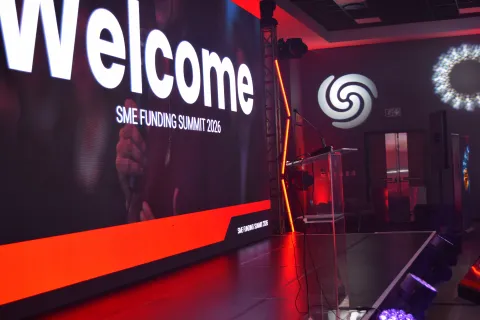


The SME Funding Summit 2026 opened with an uncomfortable truth: the money exists, the funders exist, and most small businesses still walk away empty-handed. This is why AND what to do about it. (Part 1 of the Innovation Bridge Portal’s series covering the Summit.)
Let’s start with the number that should stop every founder in their tracks.
South Africa’s MSME credit gap is R350 billion a year, and it grows annually. That is the distance between what small businesses need to operate and grow, and what they can actually get through formal channels.
Now here is the part nobody expects. That gap is not caused by a shortage of money.
Speaking at the SME Funding Summit 2026 which is the country’s premier SME funding event, hosted by SME South Africa in front of 500-plus founders and 20-plus funders and experts — FinFind CEO Darlene Menzies laid it out with the kind of clarity that reframes everything: there are more funders and more finance products in this country than ever before. Twice as many as before COVID. Enough capital, she said, to meet the need of every single SME in the room.
So if the money is there, and the funders are there, why is the gap so wide?
Because the money and the businesses can’t find each other. And once you understand why, you stop chasing funding AND start making funders chase you.
The market is bigger than you think and stacked against the small
There are 306 funders on FinFind’s database: 27 government agencies and development finance institutions, 5 large banks, 10 smaller banks, and 264 non-bank private-sector funders. Between them they offer 621 finance products.
That sounds like abundance. It isn’t BUT not for you.
Of the total corporate and business lending banks did in 2024 — somewhere between R2.2 and R2.5 trillion and only around 12% reached MSMEs. More than two trillion rand flowed to large corporates, who make up just 10% of the country’s businesses. Meanwhile MSMEs, who make up 90% of formal businesses and carry 60% of the jobs in the sector, receive less than 5% of credit and this is a figure cited by both the IFC and FNB.
And even that slice mostly bypasses you. Menzies’ data suggests the funding that does reach “small business” tends to land with the businesses turning over R5 million or more and the 9% who already have an internal bookkeeper and a staff member free to assemble a document pack. The businesses turning over under R1 million, the largest formal segment in the country, remain critically underserved.
The door is shut before you even knock
Here is the single most important insight from the entire keynote. Take a photo of this one.
The reason most SMEs don’t get funded isn’t that they fail the assessment. It’s that they never reach the assessment.
Lenders can only work with two things: the documents you hand them, or your credit history from a bureau. Most small businesses have neither in the form a lender needs so this simply means they’re simply invisible. And you cannot fund what you cannot see.
Menzies broke down exactly why the system locks small businesses out:
- The models were never built for you. Bank credit-assessment models were designed for corporate and retail consumer lending. As she put it, small businesses aren’t shrunk-down corporates — comparing the two is like comparing a human and a jackal. These models demand formal financial statements, collateral and an established credit history, which micro and small businesses rarely have.
- There is no business credit data. You know your personal credit score exists. A business equivalent, for firms turning over under roughly R10 million, is scarce to non-existent. Worse, the National Credit Act treats a business turning over under R1 million (or applying for under R250,000) like a consumer — and roughly 90% of funders quietly position themselves just above that R1-million line, where they don’t even have to tell you why they said no.
- DFIs behave like banks. The institutions meant to be your last line of defence ask, on average, for 38 documents for a single term loan — this from a sector where nearly half of sub-R1-million businesses run on three staff or fewer, including the owner. You’d have to hire someone just to apply for the funding meant to help you hire someone.
The pattern is brutal but simple: it’s not that you’re a bad bet. It’s that the system can’t read you.
Your business is already telling a story and the question is whether anyone can read it
This is where FNB Cash Advance Product Manager Prudence Gcabashe picked up the thread and turned the lens around — from the funder’s perspective to yours.
“Every payment, every deposit, every transaction tells a story about your business,” she told the room. Think of your digital financial footprint as your business CV. If it’s current, consistent and credible, a lender can see at a glance who you are, how you trade, and what kind of finance actually fits you.
Her reframe is the one to hold onto: funding isn’t only a finance issue. It’s a growth issue, a jobs issue, a family issue — and increasingly, a visibility issue. “If we don’t see you, we don’t know you’re there.” Funders can only back businesses they can understand.
So the real questions a lender asks are the same ones you’d ask if a stranger asked you for money: Can I trust you? Who are you? Can you repay? What do you need it for? Every one of those can be answered by transaction history that tells a clean, consistent story.
Become impossible to ignore
The good news running through both talks: visibility is something you control. Menzies and Gcabashe converged on the same practical playbook. Treat funding readiness as a discipline, not an event — something you work on every day, not the week you need cash.
- Manage your personal credit score. For small businesses, it’s used as a proxy for the business. Check it yourself (it’s free and doesn’t affect your score, unlike when a credit provider checks it) and act on what you find. A funder respects a plan for old debt far more than debt you’re ignoring.
- Separate business and personal finances immediately. Open a dedicated business account and run all revenue which includes cash sales through it.
- Make your bank statement tell a clean story. Six months of consistent revenue and manageable expenses beats erratic, unexplained movement every time.
- Build a paper trail. R10,000 landing every month reads better than nothing for six months and then a sudden R200,000 lump.
- Pay yourself a salary. A regular owner’s salary signals stability. If you’re short, move some back a day later, then cover expenses.
- Keep records — however simple. Consistency matters more than sophistication. As Menzies put it: sales bring in the business; only record-keeping keeps you in business.
- Sort your compliance and build a data room. CIPC registration, SARS, annual returns in order. Non-compliance disqualifies you instantly. Then put every document in one online place, ready to send.
Match the money to the need — and watch the game change
Gcabashe closed the loop with a shift in the question itself. Stop asking “Can I get funding?” Start asking “Which funding fits my need?”
- Closing a cash-flow gap? An overdraft — flexible and short-term.
- Buying stock? Trade credit or a cash advance — it improves your cash cycle.
- Buying equipment? A term loan or asset finance — matched to the asset’s lifespan.
- Expanding? A term or revolving loan — structural, repaid over the long haul.
And this is where data-driven lending rewrites the rules. Instead of 38 documents, imagine consenting to share 12 months of your bank transactions — your data, which belongs to you — and having a lender build your income view, cash-flow model and ratios in seconds. That’s the promise of open finance, and it’s exactly the logic behind products like FNB Cash Advance: it reads your real trading data to assess eligibility, requires no traditional collateral, and lets you pay as you trade and a little more on strong days, a little less on quiet ones. Become visible, and pre-approved offers stop being a mystery and start being a consequence.
The bottom line
The money is there. The funders are there. What’s missing is you — visible, readable, and ready. Or, in Menzies’ words: positive ordinary preparation precedes extraordinary accomplishment. In this country, getting funded is the extraordinary accomplishment. The ordinary preparation is entirely in your hands.
This is Part 1 of the Innovation Bridge Portal’s coverage of the SME Funding Summit 2026, hosted by SME South Africa. Over the coming instalments, we go deeper into alternative lending, procurement as a funding route, government funding pathways, and how investors really think. Follow the series so you don’t miss the sessions built for where your business is going next.