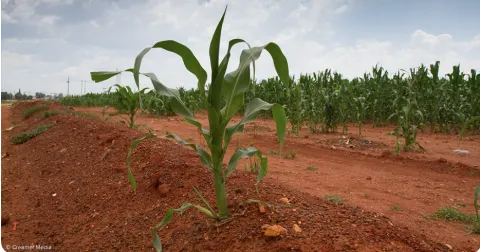


UK-based international non-profit organisation the Earth Rover Programme, which operates in Colombia, Kenya and the UK, has launched its “soilsmology” initiative globally to give farmers, including smallholders, an accurate, non-invasive way to assess soil health. The approach also enables farmers to contribute to a global “citizen scientist” soil data network through open-source, encrypted platforms, with the long-term aim of building a trusted, shared global soil map.
University of Greenwich Professor of Sustainable Agriculture and Biodiversity Jacqueline Hannam, who is involved in the programme, noted that the methods have strong potential to quantify key soil properties such as depth, bulk density and water movement without digging, which could help reverse degradation and support more sustainable management. Conventional soil monitoring is often slow, costly and reliant on invasive sampling, despite the fact that healthy soils are essential for food production and many of the world’s soils are already degraded.
To speed up and reduce the cost of sampling, the Earth Rover team has adapted seismological techniques and designed a new sensor coupled with an in-house AI model. The resulting system can support scalable soil health monitoring, map deep soil moisture, measure connected porosity and determine soil texture and soil carbon data that are critical for understanding crop resilience, water regulation and carbon storage.
Earth Rover co-founder and environmental journalist George Monbiot emphasises that the programme offers a way to “see” soil in much greater detail, helping farmers reduce environmental impacts while maintaining yields and potentially enabling new biological methods of soil improvement. The platform sends ultra-high-frequency waves into the ground using a next-generation micro electro-mechanical systems accelerometer, and the team has reduced the cost of this sensor from about US$1 000 in 2023 to around US$10, with a target of US$1 to maximise accessibility.
The AI component, known as ERP-GPT, is designed to turn complex data into clear, practical guidance for farmers, policymakers and scientists. Supported by the Bezos Earth Fund and other partners, the system has moved from proof-of-concept to pilot projects in countries including Colombia, France, Germany, Kenya and the UK, where early results show high-resolution readings at a spatial detail of about 10 cm and consistent data quality across sites in Africa, Europe and South America.
Bezos Earth Fund Future of Food director Dr Andy Jarvis said the technology makes it possible to read the “hidden world” beneath the surface without disturbing it, strengthening efforts in both climate and nature as better soil information underpins more resilient farming and land use decisions. Programme leaders have indicated that, as the technology and partnerships scale, the goal is to make tools widely available including potentially via smartphones so farmers worldwide can access soil diagnostics and management advice in an affordable, user-friendly way.
Click here to view the article.