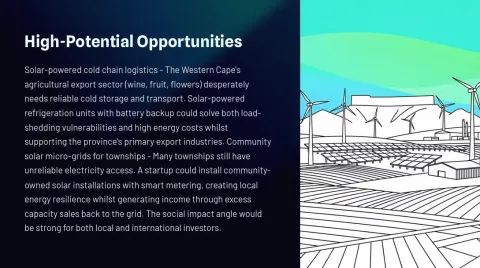


South Africa’s Western Cape is emerging as a prime testing ground for high-impact, commercially viable green energy and circular economy solutions. With a strong agricultural export base, growing manufacturing sector, world-class wind and solar resources, and acute pressure from load-shedding and water scarcity, the province offers multiple scalable opportunities for entrepreneurs and investors.
This article highlights six high-potential opportunity areas, backed by indicative market sizing, that could both drive climate resilience and unlock significant economic value in the Western Cape.
1. Solar-Powered Cold Chain Logistics
The Western Cape’s agricultural export sector (wine, fruit, flowers) relies heavily on a reliable cold chain for storage and transport. Solar-powered refrigeration units with battery backup can reduce vulnerability to load-shedding, cut operating costs, and protect export revenues.
- Western Cape agricultural exports were valued at R73.8 billion in 2024, with fruit and wine alone generating about R37 billion.
- Over 160,000 export-related agricultural jobs depend on cold-chain reliability.
- The addressable market for energy and infrastructure in the cold chain is estimated at R11-15 billion annually (15-20% of agricultural export value).
Given the frequency and cost of power disruptions, solar-powered cold storage across regions such as the Cape Winelands, Overberg and West Coast represents a fast, high-impact opportunity.
2. Community Solar Micro-Grids for Townships
Many township communities in the Western Cape still experience unreliable electricity access and under-servicing. Community-owned solar micro-grids with smart metering can improve energy security, create local income streams, and deliver strong social impact.
- The Western Cape has around 2.3 million households, with an electricity access rate of roughly 96% but an estimated 92,000 households remain underserved.
- Nationally, over 10 million South African households qualify for free basic electricity, yet only around 2 million receive it.
- Township demand is estimated at 100-150 MW across informal settlements in the province, implying a capital opportunity of about R2.5-6 billion (at R25-40 million per MW installed).
This opportunity combines revenue from energy sales with strong development outcomes, making it attractive for blended and impact finance.
3. Wind-Powered Desalination for Agriculture
Cape Town’s recent droughts have underscored the region’s water vulnerability, while the Western Cape enjoys excellent coastal wind resources. Small- to medium-scale wind-powered desalination plants serving agricultural clusters could simultaneously address water scarcity and productivity constraints.
- The Western Cape accounts for 54% of South Africa’s agricultural exports.
- Around 100,200 hectares of vines and 52,300 hectares of fruit trees require consistent water supply.
- An estimated 50-100 medium-scale desalination plants could be needed to support agricultural clusters, implying R2.5-8 billion in capital investment (at R50-80 million per plant), plus ongoing water sales revenue.
This model is particularly relevant for the wine lands and fruit-growing regions that remain exposed to climate-induced water stress.
4. Industrial Solar Leasing for SMEs
Manufacturers and food processors in the Western Cape are heavily exposed to rising electricity tariffs and grid instability. Many lack the capital or balance sheet strength to invest in solar infrastructure outright. A solar-as-a-service (leasing) model can unlock rapid scale.
- Western Cape GDP is approximately R666.8 billion, with manufacturing a significant contributor.
- Key industrial hubs include Epping, Montague Gardens, Atlantis and Saldanha.
- Commercial users face tariffs of 300-426 c/kWh (as of July 2024), while the City of Cape Town spends about 70% of its electricity tariff income purchasing power from Eskom.
- Between 2,000-3,000 SMEs could benefit from 5-20 MW of total capacity, implying a capital deployment target market of around R15-25 billion.
With proven technology and urgent demand, industrial solar leasing is ranked as the top near-term opportunity in terms of immediate viability.
5. Green Hydrogen Production from Wind
The Western Cape’s wind resources and freight infrastructure position it well for green hydrogen production in the medium to long term. Green hydrogen could serve heavy transport and industrial users, and eventually supply export markets.
- The Western Cape accounts for an estimated 17% of South Africa’s commercial diesel consumption, with 750–850 million litres used annually for heavy transport.
- South Africa has announced around USD 17.65 billion (~R330 billion) in green hydrogen investment nationally.
- Converting 5–10% of the heavy transport fleet in the Western Cape alone could represent an initial R2–4 billion infrastructure opportunity, with long-term potential in exports and industrial applications.
While capital-intensive and infrastructure-heavy, green hydrogen from wind is a major strategic opportunity with a R20–40 billion long-term market.
6. Biogas from Agricultural Waste
The Western Cape’s wine and food processing industries generate large volumes of organic waste. Converting this into biogas can create energy, reduce waste-disposal challenges, and produce valuable organic fertiliser.
- The wine sector alone generates approximately 290,000 tonnes of biomass annually from wine production.
- About 100,200 hectares of vineyards generate grape pomace, stems and wastewater suitable for biogas feedstock.
- Additional feedstock is available from fruit processing and canning plants.
- An estimated 50-100 medium-scale biogas plants could be deployed, representing R1.5–6 billion in capital investment (at R30–60 million per plant), with revenues from energy, fertiliser and waste management fees.
- A Cape Town biogas facility already processing 250 tonnes/day serves as a proof of concept.
Biogas sits mid-range in the opportunity ranking but offers a compelling triple revenue stream: waste management, energy and fertiliser.
Comparative priority: where to start?
The analysis ranks the six opportunities by immediate viability in the Western Cape:
- Industrial solar leasing for SMEs – high demand, proven technology, clear ROI.
- Solar-powered cold chain logistics – critical export infrastructure with strong economic and jobs impact.
- Biogas from agricultural waste – strong circularity case with multiple revenue lines.
- Community solar micro-grids – powerful social impact, with scope for public–private collaboration.
- Wind-powered desalination – strategically important but longer development cycles.
- Green hydrogen from wind – massive long-term potential, higher capital and infrastructure requirements.
For founders, investors and policymakers, these areas represent concrete, data-backed opportunities to drive decarbonisation, resilience and inclusive growth in the Western Cape.
Click HERE to view the full brochure.