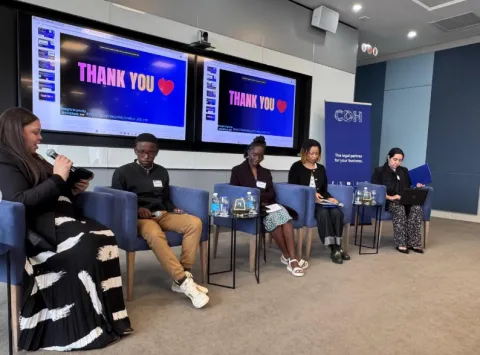


CDH, in partnership with Gender Rights and Tech (GRIT), hosted the event “From Ground to Governance: Closing the Tech-Facilitated Gender-Based Violence Gap through Research and Policy Innovation,” which served as a crucial global call to action during the 16 Days of Activism for no violence against women and children. Recognizing that gender-based violence (GBV) is a stark, lived reality in South Africa, this gathering aimed to address the evolving nature of harm, specifically the scourge of Tech-Facilitated Gender-Based Violence (TFGBV).
The event was designed not merely for abstract policy discussion but to build implementable solutions collaboratively among communities, researchers, law and policymakers, civil society, and international organizations. Digital safety, far from being a niche topic, was framed as a human rights obligation shared by all sectors, including civil society, the private sector, and government.
Grounding the Dialogue: Insights from Youth Researchers
The event prioritised moving from "the ground up" by centering the voices of trained youth researchers. Grit, the organising partner, emphasised that research must be "grounded and rooted in community truth" and designed to "shift power" rather than merely describe problems.
The youth presentations revealed significant disconnects between existing systems and the realities faced by young people online:
1. Digital Safety and Queer Youth Harassment: One youth research group, inspired by personal experiences of online negativity, focused on prioritising digital safety for queer youth. Their platform testing revealed that major social media services often do "more harm than good" due to unresponsiveness. Observations from submitting approximately 50 reports on platforms like TikTok, Instagram, and X showed that results rarely matched the type of report submitted, suggesting moderation systems are immediately disconnected from the content. Furthermore, they found that reporting processes are slow, with a reported average time to receive results ranging from 30 to 500 days, leaving almost 20 reports unanswered across three platforms. Their policy analysis of popular live service games (Fortnite, Roblox, Call of Duty) highlighted that these platforms collect an "alarming amount of user data" while making it easy to create 'burner accounts' to spread hate speech and harassment, creating a continuous cycle of harm. To combat this, they introduced The Transparent App, a proposed social instant messaging platform aiming to create a safe community space, promoting user well-being over engagement metrics and featuring an AI chatbot for sensitive discussions.
2. Cyberbullying, Law, and Mental Health: Another research group focused on cyberbullying and harassment, a topic they felt South Africa had been facing acutely. Their findings, gathered across Limpopo, Free State, and Gauteng, indicated that 50% of youth respondents have experienced cyberbullying harassment. This behaviour, predominantly occurring on WhatsApp, is driven by a lack of security and results in severe mental health issues, with half of respondents facing "drastic mental change" including anxiety, depression, and some even committing suicide. The lack of justice, driven by laws not punishing perpetrators, further deteriorates victims' mental health. The youth called for the law to start taking cyberbullying cases seriously as a crime, to implement restrictions on apps to prevent sharing images without consent, and to spread awareness.
Interrogating the Governance Gap
The subsequent intergenerational panel discussion, featuring digital rights and policy specialists alongside youth researchers, interrogated the persistent gaps between research and governance.
The Global Policy Lag: Sarah Reis, UNFPA Gender & Youth Policy Specialist, confirmed that TFGBV has increased global recognition as a "fundamental expression of GBB," noting that the continuum of online and offline violence is real. However, she stressed that policy has not caught up yet. While some countries have laws regarding cyber attacks, comprehensive legislation widely covering TFGBV is still necessary. Reis underscored that youth-led research is essential not only because young people will live longest with the problem but also because it helps "give it shape" for enforcement agents, like police, who rely on written law to take action.
Accountability and Digital Rights: Digital Rights Specialist Mardiya Siba Yahaya highlighted how technology is weaponized, making online violence often "very targeted" through phenomena like 'brigading' (making it appear many people are speaking about an issue when that's not the case). She noted that the accountability challenge is complex, involving structural inequalities sustaining offline violence. She further pointed out that governments themselves use digital tools to "silence dissents" and target human rights defenders, making the state part of the problem. Yahaya argued that meaningful accountability is needed from technology companies whose platforms are often built on "deeply insecure technology," such as the mobile money systems built on USSD.
Demands for Policy Change: Youth panellists directly confronted policymakers, asserting they "underestimate the situation" and are failing to implement policies that look "good on paper". Key demands included:
• Replacing AI moderators, which cannot detect cultural slang, with human moderators.
• Ensuring faster action on content reporting to make young people feel their voices are heard.
• Addressing the educational system where teachers are often not trained enough to handle sensitive issues like xenophobia and digital harm, leading to victims fearing to report.
• Implementing technical safety measures, such as alerting a user when someone attempts to screenshot or forward their messages on platforms like WhatsApp.
A Collective Call to Action
The event concluded with a strong recommitment to action, moving beyond the 16 Days of Activism. The need for collaboration was paramount, uniting researchers, NGO partners, public interest lawyers, and policy makers.
Grit’s work, which includes the deployment of a mobile technology featuring a data-free panic button linked to armed response and an AI chatbot named Zuzie to navigate support systems and health information in community language, serves as a model for community-rooted innovation. This model aligns with the call to action, articulated by the Digital Rights Specialist, to start thinking beyond the current model of big tech and begin building small, community-focused technological solutions that address local problems.
The core message resonating throughout the discussion was that digital harm is not an add-on issue; it is a fundamental reflection of societal violence that requires sustained honesty, accountability, and collaborative effort from every individual because the real work happens long after the event, during the "other 349 days".