

By Guy Martin, defenceWeb - 9 January 2026
The Council for Scientific and Industrial Research (CSIR) has reported strong progress across several advanced radar programmes, showcasing its growing role in defence, security and airspace management through new ground-based, naval and passive radar technologies. According to the CSIR’s 2024/25 annual report, recent work has focused on its new Ground-based Surveillance and Classification Radar (GSCR), the Quadome naval radar (developed with Hensoldt South Africa), and the StealthNet passive radar system, alongside advances in underwater communications.
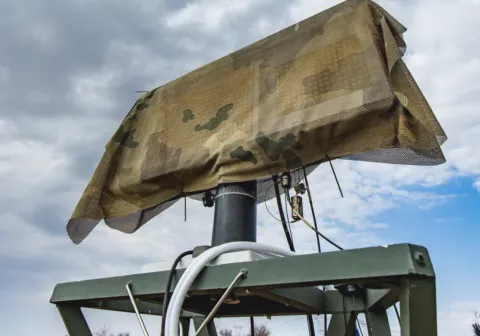
The Ground-based Surveillance and Classification Radar (GSCR) was demonstrated to defence clients during two field tests at the Rietvlei Nature Reserve near Pretoria, where it showcased its ability to monitor movement over wide areas for border and infrastructure safeguarding. Using CSIR-developed C‑band phased-array, electronically steered antenna technology, the GSCR can detect and track intruders without mechanically steering the antenna, offering a flexible and upgradeable architecture suitable for border security, critical infrastructure, farms, mines and production facilities.
A key feature of the GSCR is its integrated artificial intelligence (AI) for radar-based target classification, enabling largely autonomous operation. The system can automatically discriminate between people and other targets, triggering alerts and supporting tactical response without constant human monitoring, and is available in 4 km, 7 km and 10 km variants depending on required detection range and accuracy. The radar can also be integrated into the CSIR’s Meerkat wide area surveillance system, which combines radar, day and thermal cameras and analytics to monitor up to 200 square kilometres in support of border safeguarding, wildlife protection and rural security.
The CSIR views GSCR, together with its Tyto, Otus and RINO camera families, as modular building blocks for a broader suite of surveillance solutions, spanning wildlife protection, border safeguarding, farm and suburban security, key point security and counter air intrusion. This builds on the organisation’s long-standing radar pedigree and its work on other radar projects such as synthetic aperture radar (SAR) for unmanned aerial vehicles and the SAMURAI (Swiss African MUltistatic RAdar Initiative) drone-detection system delivered to armasuisse in Switzerland.
The Quadome radar, developed with Hensoldt South Africa, is described as the CSIR’s most notable recent radar project and the largest local radar undertaking in many years, with its first export customer being the UK’s Royal Fleet Auxiliary. Quadome is a software-defined, multi‑function cognitive radar for naval air and surface surveillance, offering rapid detection, tracking and very short reaction times for tactical naval platforms such as offshore patrol vessels, corvettes, light frigates and support ships.
Quadome provides three-dimensional air surveillance and air-defence capabilities in a compact, relatively low-mass package, with an attractive price performance ratio for vessels that might otherwise only have 2D radar. It features two primary operational modes surveillance mode for general air and surface monitoring, and self-defence mode for high-threat scenarios and target engagement while maintaining continuous helicopter support in both modes to reduce operator workload and simplify use.
The CSIR has also reported significant progress on its passive radar technology, branded StealthNet. A recent licence agreement with US-based Adler Aerospace, a company specialising in UAV and counter‑UAV technologies, will support commercialisation, particularly in airspace security and counter‑drone applications. StealthNet uses existing FM and Digital Audio Broadcasting (DAB) transmitters as “illuminators of opportunity” to passively detect targets at long range up to roughly 300 km for commercial airliner-sized aircraft, 120 km for light aircraft, 80 km for fighter aircraft and 50 km for smaller unmanned aerial vehicles.
Because passive radar exploits third‑party transmissions rather than emitting its own signal, it can be cheaper than active radar, with no need for a dedicated transmitter, fewer moving parts, lower maintenance requirements and no need for spectrum licensing. The system is also covert difficult for operators of unauthorised UAVs to detect making it attractive for airport security, national airspace surveillance and counter‑UAV missions. CSIR executives indicate that there is strong domestic and international interest, and that the technology could have broad impact across civil aviation and security markets.
Locally, the CSIR is working with Air Traffic and Navigation Services (ATNS) and the Technology Innovation Agency (TIA) to trial passive radar at Kruger Mpumalanga International Airport as part of efforts to enhance civil airspace management. Over the last eight years, the CSIR’s passive radar nodes have been deployed to multiple sites in the north‑eastern part of South Africa, including CSIR’s Pretoria campus, the University of North West (Potchefstroom), Tshwane University of Technology in Emalahleni, Hartebeeshoek and OR Tambo International Airport, forming a multi‑static passive radar network.
CSIR Group Executive for Advanced Production and Security, Dr Motodi Maserumule, notes that passive radar is particularly well suited to airport environments where detection of small UAVs is increasingly critical, given its covert nature and relatively low infrastructure footprint. Executive Manager of the Defence and Security Cluster, Sipho Mbhokota, adds that the CSIR aims to launch a passive radar-based air traffic control product and sees a large potential market in Africa, where many states struggle with comprehensive airspace surveillance. Overall, these radar developments strengthen South Africa’s indigenous technology base and open up new opportunities for export, industrial collaboration and enhanced national security.
Click HERE to visit the official website.