


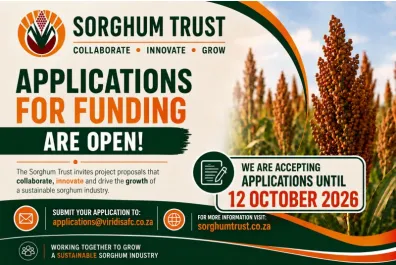
The Sorghum Trust provides financial support for projects that benefit the South African sorghum industry, with a particular emphasis on sorghum research and development and the maintenance and dissemination of information required by the industry.
The Trust's application process is designed for projects that can demonstrate a clear benefit to the sorghum industry and that have:
- A defined aim and purpose.
- A clear timeframe.
- Well-defined activities and processes.
- A realistic and justified budget.
- Identifiable benefits to relevant sectors of the sorghum industry.
WHAT TYPES OF PROJECTS CAN BE SUPPORTED?
The funding framework is deliberately centred on the sorghum industry.
Potential project areas can include work that contributes to:
Sorghum Research & Development
Projects that generate new knowledge, technologies, practices or information relevant to the South African sorghum industry. The Trust's public information identifies research and development as a core area of support.
Industry Information
Projects that generate, maintain or disseminate information required by the sorghum industry.
Industry Transformation
The application documentation specifically requires applicants to explain their BBBEE policy framework, equity, ownership and skills-development plans.
Industry-Facing Projects
Applicants must identify the sector or sectors within the sorghum industry that will benefit and explain how those benefits will be achieved.
WHO CAN APPLY?
The Trust's funding norms state that applications are considered from legal entities, rather than individuals.
The application documentation is therefore suited to organisations such as:
- Research institutions.
- Universities.
- Agricultural organisations.
- Industry bodies.
- Other eligible legal entities whose work directly relates to the South African sorghum industry.
The public Trust information also identifies organisations conducting research, collecting and disseminating market information, and implementing transformation projects in the South African sorghum industry as beneficiaries of its support.
INDIVIDUALS ARE NOT ELIGIBLE
The Funding Norms explicitly state that the Trust will only consider applications from:
Legal entities
and not from individuals.
WHAT MUST AN APPLICATION DEMONSTRATE?
The executive summary and funding norms require applicants to provide a clear project case.
Project Objective
Applicants must identify the relevant objective of the Sorghum Trust Deed under which the application is being made and explain why the proposed project contributes to that objective.
Project Purpose
The application must clearly state the:
- Main aim.
- Purpose.
- Expected contribution.
- Project timeframe.
Industry Beneficiaries
Applicants must specify:
- Which sector or sectors of the sorghum industry will benefit.
- How the project will generate those benefits.
FUNDING REQUEST & BUDGET
Applicants must provide a detailed and motivated project budget.
The application must clearly distinguish:
- Total estimated project cost.
- Amount requested from the Sorghum Trust.
- Percentage of the total project budget represented by the Trust request.
Applicants must also provide the estimated cost over the full project period, including the amount requested from the Trust for each year where relevant. All amounts must be justified and substantiated.
Funding Ceiling
The 2026 Sorghum Trust Funding Norms supplied do not state a fixed maximum grant amount.
The Trust considers applications based on factors including:
- Availability of funds.
- Cost of the specific application.
- Industry priorities.
- Benefit to the sorghum industry.
CO-FUNDING
Applicants must indicate whether:
- The Sorghum Trust will be the sole contributor; or
- Other contributors will participate.
Where there are multiple contributors, the application must specify:
- Who the contributors are.
- The extent/value of each contribution.
CAPITAL EXPENDITURE
Any capital expenditure included in the project must be explicitly identified and explained.
Applicants are required to provide details of capital items included in the application.
The Trust also considers capital items when evaluating applications.
OVERSEAS TRAVEL
Any proposed overseas travel included in the project must be:
- Clearly identified.
- Explained.
- Motivated.
The Trust specifically considers overseas travel expenses when assessing applications.
PREVIOUSLY FUNDED PROJECTS
Applicants must disclose:
- Previously funded projects.
- Whether those projects were completed successfully.
- Whether they were completed within the approved timeframe and funding.
- Any surplus Trust funding still available.
Applicants must also provide details of any similar or related projects funded by other organisations.
BBBEE / TRANSFORMATION
Applicants must provide their BBBEE policy framework, including:
- Equity.
- Ownership.
- Skills development.
The application should explain the:
Present situation and future plans.
This is therefore an important part of the application for organisations seeking Sorghum Trust funding.
TAX STATUS
Applicants must indicate whether they are:
- Registered as a Public Benefit Organisation (PBO).
- Registered as a VAT vendor.
Where applicable, the relevant PBO and/or VAT registration numbers must be provided.
PROJECT INFRASTRUCTURE & CAPACITY
The application must indicate the extent to which the applicant has the:
- Infrastructure.
- Other support measures.
necessary to execute the proposed project.
Applicants therefore need to demonstrate that the project is implementable, not simply scientifically or conceptually attractive.
PEER REVIEW
Applicants are required to provide:
Names and contact details of possible peer reviewers
for the project application.
The Funding Norms state that research proposals are sent for review to South African experts.
EVALUATION PROCESS
All applications are referred to the Sorghum Research Evaluation Committee for consideration and recommendations to the Trust.
Applicants may be required to make a presentation to the Committee.
Any expenses relating to such a presentation are the responsibility of the applicant.
The Trustees may also request additional information if necessary.
WHAT DOES THE TRUST CONSIDER?
Applications are considered on their individual merits.
The Trustees take into account factors including:
- Current requirements and priorities of the sorghum industry.
- Availability of Trust funding.
- Cost of the project.
- Overall benefit to the sorghum industry.
- Capital expenditure.
- Overseas travel expenses.
- Other matters considered relevant by the Trustees.
This means applicants should make the industry benefit extremely clear rather than presenting the work solely as an academic exercise.
RESEARCH & INDUSTRY IMPACT
The Sorghum Trust's stated mandate centres on using its discretionary funds for the benefit of the South African sorghum industry, particularly:
- Sorghum research and development.
- Information required by the industry.
- Research, market-information and transformation initiatives.
A strong proposal should therefore clearly answer:
What problem in the sorghum industry does this project solve?
Who in the industry benefits?
What will change as a result?
How will the results be disseminated and used?
RESULTS DISSEMINATION
Applicants must indicate:
- The manner and costs involved in distributing project results to the Trust.
- How results will be shared with directly affected groups in the sorghum industry.
- A communication plan for market-access or transformation initiatives where applicable.
INTELLECTUAL PROPERTY
This is an important condition.
Intellectual property capable of legal protection that emerges from Trust-funded research will, unless the Trustees agree otherwise, be:
Released into the public domain
and may not be subject to separate ownership or commercial exploitation by any person.
Applicants should therefore carefully consider this condition before proposing research that is expected to generate commercially exploitable IP.
RESULTS ACCESS
At the conclusion of a project, beneficiaries must indicate:
Where, when and how an interested party may acquire the project results.
REPORTING REQUIREMENTS
Funded projects are subject to:
- Periodic evaluation.
- Monitoring.
- Interim reports.
- Annual reports.
The Trust also reserves the right to visit project premises at any time through its trustees, administrators, auditors or appointed agents.
Interim Reports
Interim progress reports must contain information including:
- Project identification.
- Project leader.
- Actions undertaken.
- Progress made.
- Results achieved.
- Problems encountered.
- Unmet milestones and reasons.
- Expenditure statement.
- Estimated remaining duration.
Reports are required by:
15 September and 31 March
during the funding period.
Annual Report
Annual reports must additionally include:
- Comprehensive explanation of results.
- Detailed expenditure statement.
- Certification by the beneficiary's CFO or a registered accountant.
- Plans for distribution of project results.
- Potential use of results within the South African sorghum industry.
FUNDING DISBURSEMENT
Approved funding is paid in two stages:
First Payment
50% of the funded amount
after Trust approval.
Second Payment
50% of the funded amount
once the Trust is satisfied with the relevant annual progress report.
The funding timeline document also illustrates this two-stage payment structure.
FUNDING AS DONATION
Funding from the Trust is treated as a donation.
VAT is therefore calculated at a zero rate, except where otherwise specifically determined.
EMPLOYEE COSTS
The Trust's conditions place restrictions on employee costs.
Employee costs will not be funded where they form part of an application from parastatals or companies receiving grants from a sphere of government.
Funding of employee costs for private companies may be considered only in certain instances and where approved by the Trustees.
USE OF PREVIOUS FUNDING
Applicants with previous Trust-funded projects must account for:
- Progress.
- Completion.
- Funding utilisation.
- Remaining surplus.
Unresolved or surplus funding must be clearly disclosed.
PROJECT TERMINATION OR SURPLUS FUNDING
If a funded project is:
- Terminated,
- Delayed, or
- Left with surplus funding,
the beneficiary may be required to return the relevant funds or remaining balance to the Trust.
Where the Trust suspects malice and repayment conditions are not met, additional consequences can apply, including interest and restrictions on consideration of future projects.
KEY DATES
Applications Open: Funding applications are currently open
Updated Application Deadline: 12 October 2026
Click HERE to visit the official website.