
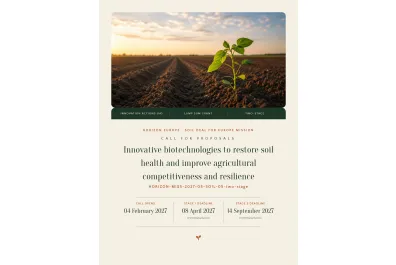
Call reference: HORIZON-MISS-2027-05-SOIL-05-two-stage
Horizon Europe has announced a forthcoming funding opportunity under the Soil Deal for Europe Mission to develop and validate innovative biotechnologies that restore soil health, remediate contaminated soils and improve agricultural productivity and resilience.
The call focuses particularly on biotechnology solutions that leverage the soil microbiome, including bio-based fertilisers and microbial inoculants. Projects should advance these solutions towards market readiness while ensuring they are scalable, sustainable, cost-effective and suitable for different environmental and agricultural conditions.
Funding and Support
- Total topic budget: €12.8 million for 2027.
- Expected EU contribution: Around €6.4 million per project.
- Indicative number of projects expected to be funded: 2.
- Funding type: Horizon Europe Innovation Action (IA), Lump Sum Grant.
- Application procedure: Two-stage call.
The expected contribution per project is indicative rather than a fixed award amount.
Purpose and Objectives
The call aims to advance biotechnology solutions that improve soil health, reduce soil pollution and strengthen agricultural competitiveness and resilience.
Expected outcomes include:
- Innovative, scalable and cost-effective biotechnologies that improve soil health, crop quality and productivity.
- Validated, market-ready solutions for soil remediation and soil health improvement.
- Reduced dependence on synthetic chemicals and improved crop resilience.
- More sustainable biomass production and improved agricultural performance.
Projects should contribute to the objectives of the EU Mission Soil and relevant European strategies on soil health, biodiversity, pollution prevention, biotechnology and sustainable agriculture.
Priority Areas and Scope
Proposals should develop, upscale, pilot and validate biotechnology solutions that restore and improve soil health across diverse soil, climate and cropping conditions.
Priority activities include:
Soil remediation and restoration
- Bioremediation of soils contaminated by heavy metals, pharmaceuticals and PFAS.
- Rehabilitation of degraded land and improvement of its ecological and economic value.
Soil health and agricultural productivity
- Increasing soil organic carbon stocks.
- Improving soil structure, biodiversity, water retention and nutrient availability.
- Enhancing crop quality, productivity and sustainable biomass production.
- Developing solutions such as novel bio-based fertilisers and microbial inoculants, particularly those leveraging the soil microbiome.
Sustainability and market readiness
Projects should assess the environmental, economic and social impacts of their solutions, including cost-benefit considerations, adoption barriers, market potential, environmental stability and adaptability to different conditions.
Proposals must also establish a pathway towards safe and effective deployment, addressing regulatory compliance, risk assessment, stakeholder engagement, market acceptance and policy considerations.
Technology Readiness Level (TRL) Requirement
Activities are expected to achieve TRL 5–6 by the end of the project, as defined in General Annex B of the Horizon Europe Work Programme 2026–2027.
- TRL 5 — Technology validated in a relevant environment. The technology must be validated under conditions relevant to its intended application. For key enabling technologies, the definition refers to an industrially relevant environment.
- TRL 6 — Technology demonstrated in a relevant environment. The technology must be demonstrated under relevant conditions. For key enabling technologies, this refers to an industrially relevant environment.
In practical terms, projects should demonstrate a credible progression beyond laboratory validation towards testing or demonstration under relevant environmental and agricultural conditions. The proposed development plan should explain how the technology will reach this maturity level by the end of the project.
Eligibility Criteria
Consortium composition
Under the standard Horizon Europe rules in General Annex B, proposals must generally involve at least three independent legal entities established in three different countries, comprising:
- At least one independent legal entity established in an EU Member State.
- At least two additional independent legal entities, each established in a different EU Member State or Horizon Europe Associated Country.
Applicants must verify any specific conditions stated in the topic documentation.
Eligibility of South African organisations
South Africa is included in the low- and middle-income countries eligible for Horizon Europe funding under General Annex B. South African organisations may therefore participate as funded beneficiaries, subject to the applicable eligibility conditions.
However, a South African organisation does not count towards the minimum consortium composition requirement described above, because South Africa is not an EU Member State or a Horizon Europe Associated Country.
South African organisations should therefore establish partnerships with eligible European or associated-country organisations and ensure that the consortium meets the minimum composition requirements.
Multi-actor approach
Proposals must involve the relevant actors across the value chain, including academia, research and technology organisations, SMEs and start-ups, investors, product developers, intellectual property and legal advisers, manufacturing and distribution partners, and end-users such as farmers and practitioners.
Applicants should also plan for collaboration with other projects funded under this topic and relevant related topics, including joint workshops, focus groups, social labs, communication and dissemination activities.
Collaboration Requirements
Proposals must include a dedicated task, appropriate resources and a plan for collaboration with other projects funded under this topic and relevant related topics.
Projects should participate in joint activities such as workshops, focus groups and social labs, organise common communication and dissemination activities, and demonstrate potential for upscaling and cross-fertilisation. The necessary budget must be allocated to these activities.
Important Dates
- Status: Forthcoming.
- Planned opening date: 4 February 2027.
- First-stage deadline: 8 April 2027 at 17:00 Brussels time.
- Second-stage deadline: 14 September 2027 at 17:00 Brussels time.
The application process is two-stage: applicants submit to the first stage by 8 April 2027. The second-stage deadline applies to proposals proceeding to that stage.
Application Process
Applications must be submitted electronically through the EU Funding & Tenders Portal.
Applicants should review the topic conditions and Horizon Europe General Annexes, confirm their eligibility and consortium composition, and prepare the required proposal documents for the relevant stage.
Industry / Sector
Agricultural biotechnology, soil health, environmental biotechnology, soil remediation, sustainable agriculture and research and development.
Click HERE to view the official website.