


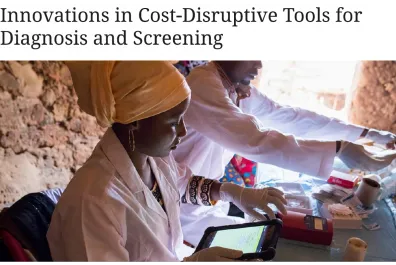
This global Grand Challenge seeks to fund breakthrough innovations that significantly reduce the cost of diagnostic and screening tools for use in low- and middle-income countries (LMICs). The focus is on developing scalable, high-impact technologies that can deliver diagnostic results at approximately USD 1 per test or near-zero incremental cost, while maintaining quality, speed, and usability in low-resource settings.
The call supports transformative approaches that rethink how diagnostics are designed, manufactured, and deployed, enabling large-scale population screening and improved disease detection.
Type of Projects to be Funded
Projects must focus on cost-disruptive diagnostic and screening innovations, including:
• Low-cost, high-throughput screening tools
• Point-of-care and decentralized diagnostic technologies
• AI-enabled or software-defined diagnostics
• Non-invasive or minimally invasive diagnostic solutions
• Modular and multi-disease diagnostic platforms
• Manufacturing innovations that reduce cost of consumables and devices
Priority disease areas include:
• Tuberculosis (TB)
• HIV
• Malaria
• Sexually transmitted infections (STIs)
• Maternal and newborn health
• Anemia and women’s health
• Enteric diseases
• Neglected tropical diseases (NTDs)
• Emerging pathogens and syndromic testing
Funding Structure
• Up to USD 300,000 (early-stage / proof of concept)
• Up to USD 500,000 (mid-stage development and validation)
• Up to USD 1,000,000 (advanced / near-deployment solutions)
• Project duration: 24–36 months depending on stage
Eligibility – Countries
• Open globally
• Strong focus on solutions applicable to low- and middle-income countries (LMICs)
Eligibility – Organisations
• Research institutions and universities
• Non-profit organisations and NGOs
• Private sector companies and startups
• Government agencies
• International organisations
Note: Individuals applying as individuals (for tax purposes) are not eligible.
Key Requirements
Proposals must:
• Demonstrate a clear pathway to ultra-low-cost diagnostics (~USD 1 per test)
• Be suitable for deployment in low-resource settings
• Include a milestone-based workplan aligned to technology maturity
• Show scalability and potential for population-level impact
• Enable rapid, accurate, and easy-to-use diagnostic outputs
What Will NOT Be Funded
• Pure research with no pathway to deployment
• Incremental improvements without cost disruption
• Projects lacking feasibility or validation pathway
• Solutions dependent on expensive infrastructure or consumables
Key Dates
• Call opens: 17 March 2026
• Webinar: 30 March 2026
• Deadline: 28 April 2026
Click HERE to visit the official website