


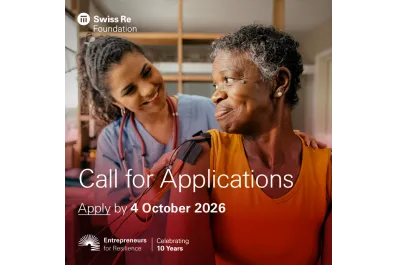
The Entrepreneurs for Resilience (E4R) 2027 programme is the 10th edition of the Swiss Re Foundation's programme supporting entrepreneurial solutions that strengthen the resilience of vulnerable communities.
This edition focuses specifically on scaling access to affordable, quality primary healthcare for underserved populations in low- and middle-income countries (LMICs).
The programme is looking for for-profit and hybrid healthcare social enterprises that have already developed and demonstrated a healthcare model and are now ready to scale their reach, strengthen their business and impact models, and serve more underserved populations.
A defining feature of this year's call is the emphasis on “brick-and-click” healthcare models, combining physical healthcare delivery with digital solutions.
THE CHALLENGE BEING ADDRESSED
The programme recognises that many people in LMICs continue to face barriers to essential primary healthcare because of:
- Cost.
- Distance.
- Limited availability of quality services.
The programme is therefore looking for scalable and sustainable healthcare models that can bring quality care closer to underserved communities while strengthening healthcare-system resilience.
WHAT IS A “BRICK-AND-CLICK” MODEL?
Applicants must combine physical and digital healthcare delivery.
The programme gives a broad, non-exhaustive illustration of potential elements of such a model, including:
- Health workers and mobile/in-clinic care.
- Pharmacies and laboratories.
- Simple diagnostics.
- Consultations.
- Virtual primary care and referrals.
- Telemedicine supporting health workers.
- Electronic medical records.
- E-pharmacy.
- Digital therapeutics.
- Chat-a-doctor services.
- Advanced AI-supported diagnostics.
- Wellness, health promotion and prevention.
- Access to over-the-counter medicines.
- Insurance protection and referrals.
- Data analytics and training.
The model does not have to contain every one of these components; the programme explicitly describes the illustration as non-exhaustive.
WHAT THE PROGRAMME IS LOOKING FOR
The programme is particularly interested in healthcare social enterprises that:
Combine physical + digital healthcare
Use a combination of physical points of care and digital solutions to improve access to primary healthcare.
Improve affordability
Use approaches such as:
- Savings.
- Payment solutions.
- Microinsurance.
to make healthcare more affordable.
Integrate with public health systems
Applicants are encouraged to demonstrate integration with:
- Government strategies.
- Public healthcare systems.
- National digital-health infrastructure.
Demonstrate scalability
The objective is not simply to operate a successful healthcare service at its current scale. The programme wants enterprises that can expand significantly over the next two to three years.
WHO CAN APPLY?
The programme specifically invites:
For-profit healthcare social enterprises
and
Hybrid healthcare social enterprises
operating within the scope of the programme.
ELIGIBILITY REQUIREMENTS
Applicants must meet all of the key eligibility requirements.
1. Healthcare Mission & Social Impact
The enterprise must:
- Improve access to healthcare in LMICs.
- Demonstrate measurable social impact.
Examples of measurable impact given in the guidelines include:
- Improved health indicators.
- Lower out-of-pocket healthcare expenses.
2. Physical + Digital Healthcare Delivery
The enterprise must combine:
Physical healthcare delivery + digital healthcare delivery.
This is a mandatory eligibility requirement, not simply a preferred feature.
3. Underserved / Low-Income Customer Base
At least 30% of the applicant's customer base must consist of low-income and underserved populations.
The enterprise must also demonstrate a deep understanding of the specific circumstances of the populations it serves.
Gender Inclusion
Priority will be given to enterprises that are gender-inclusive, particularly those striving to reduce gender inequalities.
4. Geography
Applicants must operate in countries defined by the World Bank as low- and middle-income countries (LMICs).
5. Legal Structure
The enterprise must:
- Be formally registered as a for-profit, or
- Operate through a formally established hybrid structure.
The organisation must have been established no later than December 2023.
6. Revenue Model
At least 50% of the organisation's income must come from earned revenue.
Applicants must also demonstrate that their business model has the potential to grow and scale through a market-based revenue model.
7. Existing Reach
Applicants must already serve at least:
50,000 people
and demonstrate the potential for substantial acceleration over the next two to three years.
This means the opportunity is aimed at established, operating enterprises, rather than early-stage healthcare start-ups that are still proving their basic business model.
8. Management Team
Applicants must have:
- A strong management team.
- Clearly defined and distributed responsibilities.
- A diverse and well-structured workforce.
Preference will be given to enterprises with:
- At least one female founder, or
- At least 30% women in the management team.
9. Legal Compliance
Applicants must comply with the laws and regulations of the countries in which they operate and must be legally able to receive funding from a Swiss non-governmental organisation such as the Swiss Re Foundation.
FUNDING & SUPPORT
The programme combines funding with technical support, advisory services, networks and exposure.
Pilot Funding
For the 6–8 shortlisted social enterprises during due diligence:
Up to USD 45,000
This funding may be used to test targeted initiatives aimed at:
- Increasing impact.
- Validating new approaches.
Finalist Funding
For the 3–4 finalists, up to:
USD 1 million in blended funding
will be allocated across the finalists over a two-year implementation period.
The detailed funding structure is:
- Up to USD 600,000 in unconditional funding shared across the 3–4 finalists.
- Up to USD 400,000 in conditional funding shared across the finalists based on progress and agreed milestones.
Important
The programme does not award USD 1 million to each finalist.
The up to USD 1 million is shared among all 3–4 finalists.
TECHNICAL ASSISTANCE
For 6–8 Shortlisted Enterprises
Shortlisted enterprises receive:
3 days of tailored technical assistance
during the due diligence phase, focused on:
- Impact measurement.
- Impact management.
The due diligence process will also produce recommendations and materials that the shortlisted organisations can use with potential:
- Investors.
- Donors.
- Partners.
For 3–4 Finalists
Finalists receive up to:
20 days of tailored technical assistance over two years
covering areas including:
- Advanced impact measurement and management.
- Financial management.
- Fundraising.
- Scaling.
- Last-mile marketing and sales.
- Gender inclusion.
Finalists also gain access to corporate expertise from Swiss Re employees and programme partners.
NETWORKS & EXPOSURE
Programme participants can access:
- Increased visibility across healthcare, philanthropy and impact-investing sectors.
- A network of healthcare social enterprises.
- Knowledge and best-practice exchange.
- Investors.
- Corporate experts.
- Strategic partners.
The programme also includes the People's Choice Award, determined through a public online vote, providing an additional growth and impact opportunity for the winner.
The Entrepreneurs for Resilience gathering is planned to take place in Zurich, Switzerland, in November 2027, although the date is noted as TBC in the guidelines.
APPLICATION PROCESS
The programme uses a multi-stage selection process.
Stage 1 — Initial Application
Applications are screened based on:
- Key eligibility.
- Impact.
- Traction.
- Strategic fit.
Up to 25 social enterprises will be invited to proceed to the second round.
Stage 2 — Detailed Application
The second-round application assesses:
- Business model.
- Growth trajectory.
- Growth potential.
- Operations.
- Team.
- Impact measurement approach.
From this process:
6–8 social enterprises will be shortlisted for due diligence.
Stage 3 — Due Diligence
Between:
November 2026 and March 2027
the 6–8 shortlisted enterprises undergo comprehensive due diligence.
This includes:
- On-site visits of up to four days.
- Tailored technical assistance.
- Potential pilot funding of up to USD 45,000 to test targeted initiatives or validate approaches.
Stage 4 — Finalist Selection
After due diligence, shortlisted enterprises receive support preparing for their final presentation.
Virtual preparation sessions with the programme jury take place in:
May 2027
Based on due diligence findings and final presentations, the jury selects:
3–4 finalists.
Stage 5 — Two-Year Finalist Programme
Finalists receive funding and tailored technical assistance against agreed milestones and deliverables.
The funding is provided through separate agreements with the Swiss Re Foundation.
Finalists enter into a two-year agreement covering:
- Key milestones.
- Expected deliverables.
- Impact measurement requirements.
Funding is paid over the two-year period based on progress against agreed milestones and deliverables.
EVALUATION CRITERIA
Applications are assessed against five key elements:
Strategic Fit
How well the enterprise fits the programme scope.
Social Impact
The impact being created for underserved populations.
Business Sustainability
The strength and sustainability of the underlying business.
Scalability Potential
The potential to significantly expand reach and impact.
Team Strength & Diversity
The strength, structure and diversity of the management and wider team.
INTELLECTUAL PROPERTY
All ideas submitted remain the property of the applicant.
Applications are shared with the programme jury and LeFil Consulting, which supports the Swiss Re Foundation in programme management.
Everyone with access to applications must sign a confidentiality agreement.
IMPORTANT APPLICANT CONSIDERATIONS
This is an opportunity for scaling established healthcare social enterprises, not a general start-up grant.
Applicants should be particularly careful about the following thresholds:
- Must combine physical and digital healthcare delivery.
- At least 30% of customer base must be low-income/underserved.
- At least 50% of income must come from earned revenue.
- Must already serve at least 50,000 people.
- Must have been established by December 2023 at the latest.
- Must operate in a World Bank-defined LMIC.
- Must be formally registered as a for-profit or hybrid enterprise.
- Must demonstrate measurable social impact and significant scaling potential.
These requirements mean that a promising healthcare start-up that is still early in its market development is unlikely to meet the programme's stated eligibility criteria.
KEY DATES
Applications Open: 7 September 2026
Application Deadline:
4 October 2026 | 23:59 CET
Second-Round Applications:
By 8 November 2026 | 23:59 CET
Due Diligence:
November 2026 – March 2027
Finalist Preparation:
May 2027
Entrepreneurs for Resilience Gathering:
November 2027 in Zurich, Switzerland — TBC.
COUNTRY / GEOGRAPHIC SCOPE
International
The programme requires applicants to operate in World Bank-defined low- and middle-income countries.
Click HERE to visit the official website.