


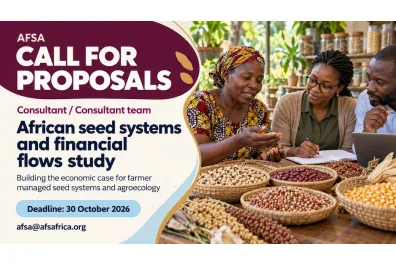
The Alliance for Food Sovereignty in Africa (AFSA) is inviting proposals from individual consultants or multidisciplinary teams to conduct a study examining African seed systems, the financial flows shaping them, and the economic and wider benefits of farmer-managed seed systems (FMSS) and agroecology.
The assignment aims to strengthen the evidence available to donors, development finance institutions (DFIs) and philanthropic foundations when determining funding priorities and investment approaches for African agriculture.
Building on AFSA's existing research, the study will assess how public, private and philanthropic finance reaches different seed-system models, identify who benefits, and evaluate the evidence on yields, production costs, household income and profitability. It will also examine wider outcomes relating to climate resilience, nutrition, biodiversity and livelihoods.
The findings will inform practical, evidence-based recommendations for improving how agricultural and seed-system initiatives are financed across Africa.
Purpose and Objectives
The assignment has four principal objectives:
- Assess African seed systems: Examine their current status, diversity and key trends, including farmer-managed systems, public seed provision and commercial seed markets.
- Map financial flows: Identify where public, private and philanthropic finance is directed, who benefits and how much demonstrably supports farmer-managed seed systems and agroecology.
- Strengthen economic evidence: Synthesise existing research and document additional case studies to assess economic performance and wider development outcomes.
- Develop financing recommendations: Propose practical changes to funding priorities, investment criteria and financing mechanisms for donors, DFIs and philanthropic foundations.
Scope of Work
The selected consultant or team will undertake the following activities:
1. African Seed Systems Assessment
- Examine seed sourcing, saving, exchange, local sales, breeding, selection, multiplication and distribution.
- Assess seed access, affordability, availability, quality, crop diversity and farmer control.
- Examine the roles of farmers, community seed banks, cooperatives, enterprises, public institutions, women and youth.
- Analyse relevant market structures, agricultural research, extension services and institutional conditions.
2. Public, Private and Philanthropic Finance Mapping
- Review national budgets, public research and extension funding, seed and input subsidies, development assistance and DFI investments.
- Examine commercial seed-company investments, agribusiness finance, private equity, venture capital and impact investment.
- Assess philanthropic grants, blended finance, concessional capital, guarantees and technical assistance.
- Identify funding gaps, barriers to access and opportunities to improve alignment with farmer-managed seed systems and agroecology.
3. Economic and Financial Evidence
- Analyse yields, production costs, gross margins, farm profitability, household income and returns to land and labour.
- Assess income and yield stability, exposure to price and weather shocks, and recovery from disruptions.
- Examine wider outcomes relating to climate resilience, nutrition, biodiversity, gender, youth and livelihoods.
- Distinguish verified results from estimates, qualitative evidence and unresolved data gaps.
4. Case Studies and Stakeholder Engagement
- Propose 8–10 case studies, including at least four newly documented cases.
- Engage AFSA members and other networks to identify relevant examples across diverse African contexts.
- Conduct desk research, remote interviews and case documentation.
- Develop evidence-based recommendations for improving funding decisions and agricultural finance practices.
Geographic Scope
The study will provide a continental overview of African seed systems, supported by a purposive selection of countries and case studies spanning different African subregions, Francophone and Anglophone contexts, farming systems and institutional models.
The final country sample and institutional coverage will be agreed with AFSA during the inception phase. The assignment does not prescribe a fixed list of countries or require a continent-wide survey.
Who Can Apply?
The opportunity is open to:
- Individual consultants with relevant specialist support.
- Small multidisciplinary consulting or research teams.
- Researchers and professionals with demonstrated expertise in African agriculture, seed systems, agroecology, agricultural economics or development finance.
Applicants must demonstrate the ability to undertake detailed financial research alongside farmer-centred evidence documentation and synthesis.
Required Expertise
Proposals should demonstrate:
- Substantial experience researching African agriculture, farmer-managed seed systems or agroecology.
- Expertise in analysing DFI portfolios, public expenditure, private investment and development finance.
- Strong agricultural economics skills, including farm budgeting, income and profitability analysis.
- Experience in literature reviews, evidence synthesis, case-study research and assessing the strength of evidence.
- Ability to work respectfully with farmer organisations and local knowledge networks.
- Excellent written English and a credible approach to French-language engagement and outputs.
- Appropriate quality assurance and management of potential conflicts of interest.
Required Deliverables
The assignment will produce six main deliverables:
- Inception report: Research protocol, workplan, source inventory, finance classification framework and case-study selection plan.
- Interim finance mapping: Preliminary financial dataset, DFI tracking brief, initial findings and documented evidence gaps.
- Evidence dossier: Structured literature review, evidence matrix and 8–10 draft case profiles, including at least four newly documented cases.
- Integrated draft report: Approximately 35–45 pages, excluding annexes, accompanied by an executive summary and draft funder decision brief.
- Validation session: Online presentation and discussion of findings with AFSA and invited network representatives.
- Final package: Revised report, final case studies, complete finance dataset, data dictionary, 4–6-page funder decision brief, prioritised recommendations matrix and an approximately 12-slide presentation.
Core outputs will be in English. The executive summary, funder decision brief and case documentation toolkit must also be provided in French.
Contract Duration and Financial Proposal
- Duration: 14 weeks from contract signature.
- Budget: No fixed contract value is specified in the Terms of Reference. Applicants must submit an itemised financial proposal covering person-days, daily rates, research assistance, data access, translation, interpretation, member support, validation activities and applicable taxes.
- Applicants should clearly identify assumptions, exclusions and optional costs.
Selection Criteria
Proposals will be assessed on:
- Methodological strength and quality of the proposed research approach.
- Relevant expertise and previous assignments.
- Capacity to deliver financial mapping and evidence synthesis.
- Quality of previous research and writing outputs.
- English-language and French-language capacity.
- Feasibility of the workplan and delivery arrangements.
- Value for money.
Important Dates
- Application deadline: 30 October 2026
- Contract duration: 14 weeks from signature
Application Requirements and Submission
Applicants must submit:
- A concise technical proposal outlining the assignment's interpretation, methodology, coverage, case-study approach, workplan, team responsibilities and quality assurance.
- CVs for the proposed consultant or team.
- Two relevant research or writing samples.
- References from comparable assignments.
- An itemised financial proposal with costs, assumptions and exclusions.
Submission email: afsa@afsafrica.org
Email subject: Proposal for African seed systems and financial flows study
Click HERE to visit the official website.