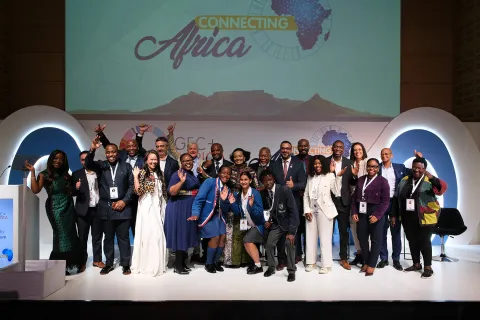


The opening of the continent's largest entrepreneurship gathering set out the cost of a fragmented Africa, the narrowing of global capital, and the standard against which our ecosystems should be measured.
Part 1 of the GEC+Africa 2026 series | Innovation Bridge Portal
The Global Entrepreneurship Congress+Africa 2026 opened in Cape Town on 16 September under the theme "Connecting Africa". Over two days, the congress convened entrepreneurs, investors, policymakers, development partners, corporates and ecosystem support organisations from across the continent and beyond. The opening session established the analytical frame for everything that followed, and it is worth recording carefully, because the argument it advanced has direct implications for how South Africa positions its innovators.
The cost of disconnection is measurable
Kizito Okechukwu, Co-Chair of GEN Africa and Executive Head of 22 On Sloane, opened with an illustration drawn from his own experience. At a restaurant in Lagos, he asked where the salmon on his plate had come from. The answer was Norway which is approximately 6,000 kilometres away while Cape Town sits roughly 4,000 kilometres down the same coastline.
The illustration carries a documented cost. Logistics costs across Africa can run up to five times higher than in other regions, and it is in some cases cheaper to ship goods from Asia to Africa than between neighbouring African states. Because international capital markets price the continent on perceived systemic risk rather than demonstrated performance, Africa is penalised by an estimated USD 75 billion annually.
His central question was directed at the continent's own institutions rather than at external actors: how can Africa be connected if Africans are not connected to one another? Markets remain separated by costly borders, uncoordinated regulation and infrastructure gaps. The African Continental Free Trade Area creates the legal conditions for integration, but the movement of people, goods and capital has not yet followed.
For South African innovators, this is not a continental abstraction. It explains why an addressable market is smaller than it should be, why input costs are higher than they should be, and why domestic capital is more expensive than it is for competitors in better-rated regions.
The global map of opportunity is narrowing
Jonathan Ortmans, Founder and President of the Global Entrepreneurship Network, presented the session's most significant data. Drawing on a decade of tracking approximately 5.5 million companies across 350 ecosystems, he described not a map of the world as it is, but a map of where capital currently believes the future is being built.
The headline finding is a contradiction. Global startup ecosystem value rebounded by close to 40% last year following a severe post-pandemic contraction. However, roughly two-thirds of that growth landed in three American cities, and close to nine in every ten late-stage dollars now flows into artificial intelligence, deployed in a single region. The entrepreneurial economy has never created more value, and has never created it in so few places. Cape Town, Lagos and Nairobi all sit in relative shadow on that map as, notably, do Paris, Seoul and São Paulo.
Four developments produced this concentration: development assistance contracted by the largest margin recorded in a single year, falling roughly 23% in twelve months on OECD preliminary figures, with a steeper decline on this continent; advanced economies redirected spending inward; trade, capital and talent began moving along political rather than commercial lines; and artificial intelligence drew substantial capital toward a small number of locations. No single decision redrew the map. Four separate decisions, taken independently, did so collectively.
The important qualification is that this is a result rather than a law. Almost every Chinese ecosystem in this year's top 40 lost ground, including Beijing, Shanghai and Shenzhen. In the same period, Sri Lanka advanced more than 65 places, the largest single movement in the ranking. Incumbency guarantees nothing, and neither does distance from capital.
Four responses available now
The address concluded with four courses of action, each of which falls within the existing mandate of ecosystem actors in South Africa.
First, measure outcomes and publish them. This was directed at entrepreneur support organisations, incubators, accelerators and programme funders, and it was the least comfortable item on the list. Too many programmes report enrolments, events held and founders engaged, while remaining silent on how many enterprises were created and are still trading, how many jobs resulted, and whose circumstances changed. When capital tightens, it moves toward demonstrable results. The historical objection that rigorous longitudinal evaluation costs more than most programmes can afford has been materially weakened by the availability of AI-enabled tracking.
Second, design the regulatory conditions in which capital can operate. Tunisia's Startup Act is the working example. World Bank economists found that labelled firms were 18 percentage points more likely to survive and approximately doubled their headcount. The determining factors were not tax incentives but administrative ones: faster customs processes, lighter paperwork and the right to hold foreign currency.
There is also precedent for what succeeds a contracting aid model. Following the fall of the Berlin Wall, ten enterprise funds were capitalised across 19 countries with USD 1.2 billion, placed under private boards investing for a return rather than administered as assistance. Those funds returned USD 1.7 billion in net proceeds, mobilised a further USD 6.9 billion in private capital, and supported as many as 300,000 jobs. What is ending is a funding instrument, not the development mandate itself.
Third, widen participation. The most consequential shortage is not capital but the number of people who consider enterprise a viable path. Concentration is demographic as well as geographic: the share of female founders across Africa's startup ecosystems sits at approximately 14%, higher than Europe's, and still substantially below the continent's potential. The evidence that exposure works at scale is African: Algeria hosted the largest Global Entrepreneurship Week campaign worldwide last November, with more than 30,000 registered events, and Ethiopia followed with more than 20,000 — against 28 events three years earlier.
Fourth, design for cross-border participation from the outset. Ten years of ecosystem data indicate that ecosystems with the highest levels of external connectivity consistently outperform those that do not. The cost of isolation is quantifiable: Africa accounts for roughly 18% of the world's population and under 1% of global data centre capacity, and the continent's five largest markets together operate under 500 megawatts, against approximately 800 megawatts for France alone. More than 50 African governments have signalled support for a proposed USD 60 billion continental artificial intelligence fund. It is not yet capitalised and its governance remains unresolved, but the proposition it concedes is instructive: no single country can finance this capacity alone, and participation does not require ownership.
The provincial perspective
Tertuis Alfred Simmers, Acting Premier and Provincial Minister in the Western Cape Department of Infrastructure, delivered the opening address on growth, jobs and inclusive prosperity, and set out the public-sector counterpart to the same argument. His formulation was direct: infrastructure is not separate from economic policy; infrastructure is economic policy.
The province has set a target of a R1 trillion inclusive economy by 2035, growing at between four and six percent annually. Its official unemployment rate stands at 19.5% against a national average of 33.6%, with 91,000 jobs added over the past year. The Department of Infrastructure is deploying a R9.6 billion budget in the current financial year, with the City of Cape Town planning a R43 billion infrastructure investment over three years.
Two propositions from that address bear repeating. To entrepreneurs: the ambition should not be to build a successful Cape Town company, but a successful African company from Cape Town. To government: its function is not to stand in front of entrepreneurs but to clear the road ahead of them, since every unnecessary permit costs time, every regulatory delay costs money, and every avoidable barrier represents a job that was not created.
Growth is not the same as development
The congress was subsequently addressed by His Excellency, former President of the Republic of South Africa, Mr Kgalema Motlanthe, who spoke in his capacity as patron of the Kgalema Motlanthe Foundation. His address supplied the normative frame that the data alone cannot.
Its central proposition was a correction to a long-standing assumption. For decades the expectation has been that if economies grew, if gross domestic product rose, if foreign direct investment increased and commodity exports expanded, broader development would follow. The evidence of the past half-century records something different: growth without development, rising GDP alongside rising inequality, and national wealth increasing while household conditions stagnated. This is not an argument against growth, which remains necessary. It is an argument that growth alone is insufficient, and that what is required is structural transformation economies restructured to serve the many rather than the few. The position aligns with that of the United Nations Economic Commission for Africa, which holds that Africa's future cannot be secured through growth alone, and that innovation, data and new technologies must be used to raise productivity, diversify economies and distribute the resulting wealth.
He located that transformation on three pillars. The first is leadership, understood broadly in government, business, academia, civil society and communities and required to be both visionary and operational, since vision without execution is utopian and execution without vision is drift. The second is entrepreneurship, with a standard that is unusually clear: a continent where it is easier to start a business than to seek employment, where access to finance is a right rather than a privilege, and where failure is treated as a lesson rather than a stigma. Achieving it means streamlining registration, digitising regulatory systems and removing bureaucratic impediments and extending that work beyond company formation to the conditions in which enterprises navigate regulation, reach markets and compete.
The third is innovation, in three connected forms. Digital innovation, which allows the continent to leapfrog conventional development pathways in education, healthcare and agriculture, but which requires African-led research, data infrastructure and investment. Green innovation, through which the continent's renewable resources, sustainable agriculture and clean technologies can support a fair low-carbon transition that builds local industries and jobs. And social innovation, drawing on values such as Ubuntu to shape public services, social cohesion and resource management. He cited M-Pesa's transformation of financial services and pointed to South African platforms digitising farmer aggregation and stokvel-based savings as evidence that the model is already operating locally.
Two elements of that address warrant particular attention within the national system of innovation. The first is his identification of public procurement and public institutions as instruments for supporting local entrepreneurial experimentation and learning, placing the state's purchasing power inside innovation policy rather than alongside it. The second is his framing of demographics: by 2050 the continent will be home to over 800 million young people, and that population is not a burden to be managed but capacity to be released.
His closing instruction was that each delegate leave with a specific commitment policymakers to remove barriers to enterprise, business leaders to support young entrepreneurs, entrepreneurs to share their lessons, and young people to commit to learning and perseverance. The past is inherited; the future is created.
From commitment to infrastructure
The congress also produced an operational instrument. KUMii was launched as the legacy project of GEC+Africa 2026: an AI-enabled platform consolidating access to funding, market opportunities, mentorship, business readiness tools and business software, and already carrying more than 4,000 users. The name draws on two African languages which is kujenga, Swahili for "build", and yami, isiZulu for "mine".
The problem it addresses will be familiar to users of the Innovation Bridge Portal. South Africa has over 300 funders and more than 200 registered private lenders serving small business. Most entrepreneurs cannot name a fraction of them, are uncertain which instrument suits their requirement, and are not documentation-ready when a suitable match does appear. Fragmented information is not an administrative inconvenience. It functions as a filter that removes viable enterprises from the market before any assessment of their quality takes place.
What this means for the South African ecosystem
The consistent thread across the opening session is that the distance between an innovator and an opportunity is rarely a distance of quality. It is a distance of visibility, and visibility is something an ecosystem can deliberately engineer.
That is the function the Innovation Bridge Portal performs within South Africa's national system of innovation: reducing the distance between innovation and opportunity, between publicly funded research and a market able to absorb it, and between a South African solution and a continental customer. In a period when capital is concentrating into fewer locations and scrutinising outcomes more closely, that function moves from useful to structurally necessary.
None of the responses set out in Cape Town requires a donor decision, a summit outcome or a change of policy on another continent. Each falls within the existing capacity of institutions already operating in this ecosystem.
This is the first article in a series on GEC+Africa 2026. The programme was substantial, and each session merits examination on its own terms rather than compression into a single summary. Further instalments will follow.